
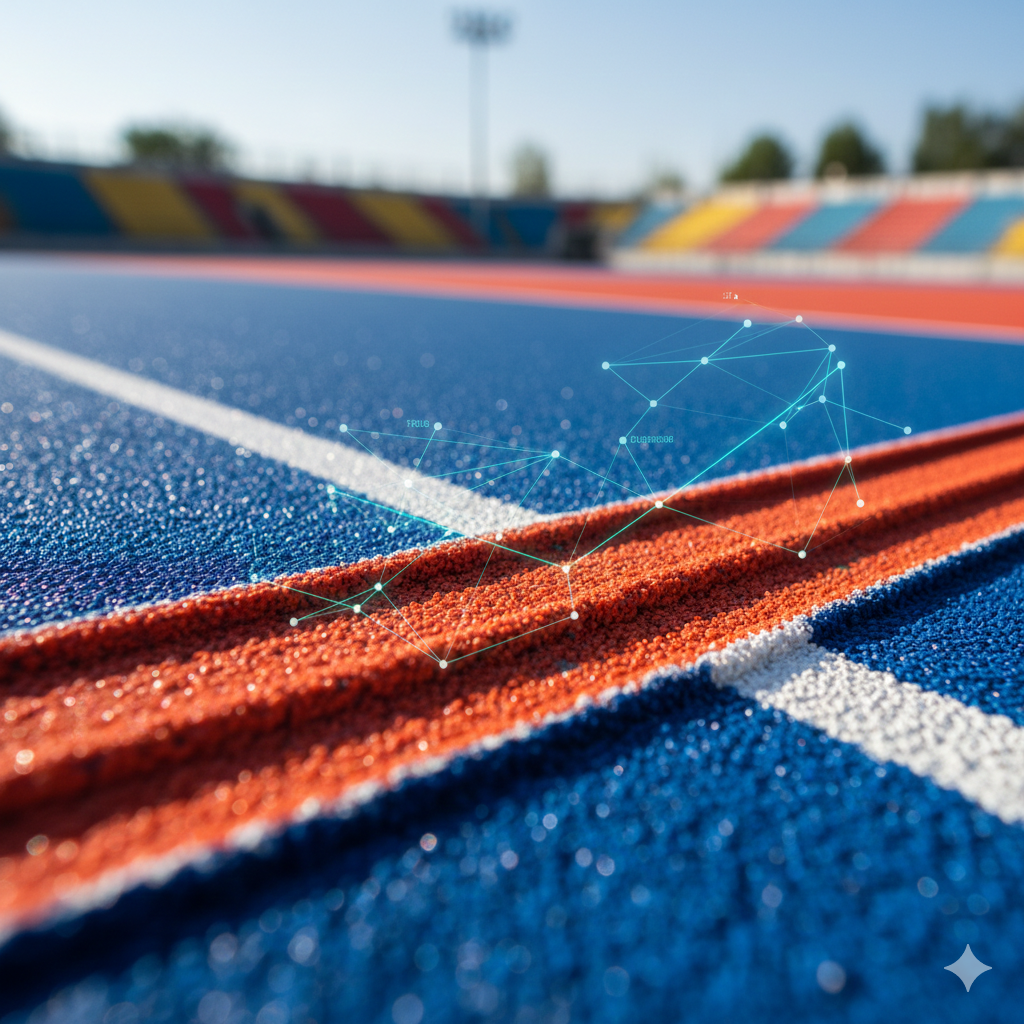
Understanding the science that delivers durability, performance, and long-term reliability in modern sports surfaces.
🌟 Introduction: Where Sports Meets Chemistry
When athletes steps onto a vibrant acrylic sports court, they experience speed, grip, consistency, and safety – but behind that smooth surface lies a sophisticated blend of polymer chemistry, pigment science , fillers and curing technology.
Acrylic sports flooring system are not just paint coating. They are engineered multilayer polymer systems designed to withstand:
✔ Extreme weather
✔ UV radiation
✔ Heavy mechanical wear
✔ Moisture exposure
✔ Thermal expansion
Understanding the chemistry behind acrylic flooring helps facility planners, engineers, and manufactures optimize performance, lifespan, and sustainability. 🧬
🧬 What Is Acrylic Sports Flooring?
Acrylic sports flooring is a water-based polymer coating system applied in multiple layers over asphalt or concrete substrates. The primary binder is acrylic polymer emulsion, which forms a tough, flexible, and weather-resistant film after curing.
Unlike solvent-based coatings, modern acrylic systems are:
🌱 Low VOC
💧Water-dispersed
☀ UV-stable
♻ Environment-friendly
These properties make acrylic surfaces ideal for outdoor and semi-outdoor sports courts such as tennis, basketball, pickleball, volleyball, and multi-purpose courts.
🧪 Core Chemical Components of Acrylic Flooring Systems
Let’s break down the formulation layer by layer.
🧫1. Acrylic Polymer Binder – The Backbone
The binder is the heart of the system. It is typically a copolymer emulsion made from:
- Methyl Methacrylate (MMA)
- Butyl Acrylate
- Ethyl Acrylate
- Styrene-modified acrylics (optional)
These monomers are polymerized into long-chain molecules suspended in water.
🔬 Why this chemistry matters:
✔ Provides flexibility and crack resistance
✔ Creates strong adhesion to substrates
✔ Resists UV degradation
✔ Maintains elasticity over temperature changes
✔ Forms a continuous waterproof film
The glass transition temperature (Tg) of the polymer is carefully engineered to balance hardness and flexibility.
🎨 2. Pigments – Color Stability & UV Protection
Pigments deliver vibrant color and UV resistance. Common pigments include:
- Titanium Dioxide (TiO2) for opacity and brightness
- Iron Oxides for reds, yellows, and browns
- Organic pigments for vivid blues and greens
High-quality pigments resist:
☀ UV Fading
🌧 Moisture bleeding
🧪 Chemical degradation
Pigment particle size and dispersion affect surface smoothness and color consistency.
🪨 3. Fillers & Aggregates – Texture and Performance
Fillers are added to control texture and mechanical properties:
- Silica sand
- Calcium carbonate
- Quartz powder
- Rubber micro-granules (in cushioned systems)
Their functions:
✔ Adjust slip resistance
✔ Improve abrasion resistance
✔ Control film thickness
✔ Enhance ball bounce behavior
✔ Improve load distribution
Particle grading plays a major role in surface friction and comfort.
⚗️ 4. Additive – Performance Enhancers
Small percentages of additives significantly impact behavior:
- Dispersants: Maintain pigment stability
- Defoamers: Prevent air bubbles
- Thickeners: Control viscosity
- Biocides: Prevent microbial growth
- UV stabilizers: Extend color life
- Wetting agents: Improve substrate penetration
💧 5. Water- The Eco-Friendly Carrier
Water acts as the carrier medium for the polymer emulsion. As water evaporates during drying, polymer particles coalesce into a continuous film.
This makes acrylic systems:
🌍 Safer for installers
🌿 Environmentally responsible
🔥 Non-flammable
🧪 The Curing Process: How Acrylic Becomes a Solid Surface
Unlike cement curing, acrylic is a physical film formation process:
1️⃣ Water evaporates
2️⃣ Polymer particles come into contact
3️⃣ Particles deform and fuse
4️⃣ Continuous polymer film forms
5️⃣ Mechanical strength develops over 24-72 hours
Temperature, humidity, airflow, and substrate moisture strongly influence curing quality.
🏗️ Multilayer System Architecture
A typical acrylic sports flooring system includes:
🔹 Primer Layer
- Enhances adhesion
- Seals pores
- Improves bonding
🔹 Cushion Layer (optional)
- Rubberized acrylic
- improves shock absorption
🔹Texture Layer
- Contains silica aggregates
- Controls traction
🔹Color Finish Layers
- UV-resistant pigmented coats
Each layer has a distinct chemical formulation tailored for performance.
📊 Comparative Performance of Acrylic vs Other Sports Flooring Materials
Understanding acrylic chemistry becomes even more meaningful when compared with other common sports flooring materials. Each material has unique molecular behavior, mechanical performance, and environmental characteristics.
| Property | 🧪 Acrylic Flooring | 🧩 PP Interlocking Tiles | 🧪PVC Sports Flooring | 🟠 EPDM Rubber Flooring |
| Base chemistry | Water-based acrylic polymer emulsion | Polypropylene thermoplastic polymer | Polyvinyl chloride with plasticizers | Synthetic rubber granules bonded with PU binder |
| Flexibility | Medium-High (controlled by polymer Tg) | Medium (rigid tile structure) | High (plasticized vinyl) | Very High (elastic rubber) |
| UV Resistance | Excellent | Moderate (UV stabilizers required) | Moderate (may fad over time) | Excellent (pigmented EPDM granules) |
| Slip Control | Adjustable via silica aggregates | Molded surface texture | Embossed wear layers | Granule texture provide grip |
| Shock Absorption | Moderate (can be enhanced with cushion layers) | Moderate | High | Very High |
| Weather Resistance | Excellent for outdoor exposure | Good, thermal expansion must be managed | Mainly indoor | Excellent |
| Installation Type | Liquid-applied multilayer coating | Modular snap-fit tiles | Sheet or roll installation | poured-in-place system |
| Maintenance Chemistry | Easy cleaning, recoating | Tile replacement | Requires controlled cleaning chemicals | Occasional resealing |
| Sustainability Profile | Low VOC, water-baed | Recyclable plastic | Recycling limited | Recycled rubber options available |
| Lifespan Behavior | Recoatable, long service life | Tile aging under UV | Plasticizer migration over time | High durability |
This comparison highlights why acrylic systems remain one of the most balanced solutions for outdoor performance, environmental safety, and long-term surface consistency.
🌦 Weather & UV Resistance Chemistry
Acrylic polymers naturally resist photodegradation. UV stabilizers and pigment selection further enhance durability.
The polymer backbone resists:
☀ Yellowing
🌧 Hydrolysis
❄ Thermal cracking
🌬 Oxidation
This ensures long outdoor lifespan even in harsh climates.
🛡️ Chemical Resistance & Maintenance Behavior
Acrylic coating resist:
✔ Mild acids and alkalis
✔ Cleaning detergents
✔ Sweat and salts
✔ Rainwater pollutants
However, strong solvent should be avoided to prevent polymer swelling.
♻ Sustainability & Environmental Chemistry
Modern acrylic flooring supports:
🌱 Low VOC emissions
♻ Water-based processing
🌍Reduced carbon footprint
🚯Long lifecycle reducing waste
Some systems incorporate recycled fillers or bio-based additives.
🔮Future Innovations in Acrylic Flooring Chemistry
Emerging developments include:
🚀 Self-cleaning coatings
🧬 Nano-reinforced polymers
🌡 Heat-reflective pigments
📊 Smart coatings with sensors
♻ Fully recyclable polymer systems
🧾 Conclusion
Acrylic sports flooring is a remarkable blend of polymer chemistry, material engineering, and environment science. From the molecular structure of the binder to the particle size of fillers, every chemical choice influences performance, durability, safety, and sustainability.
Understanding this chemistry empowers better design, manufacturing, and long-term performance optimization for sports infrastructure worldwide.🏟️
❓Frequently Asked Questions (FAQs)
Q1. What makes acrylic flooring suitable for outdoor courts?
Ans:- Acrylic Polymers are naturally UV-resistant, water-resistant, and flexible across temperature ranges. Their water-based chemistry allows them to form a seamless protective film that withstands sunlight, rain, and surface abrasion without rapid degradation.
Q2. How long does acrylic sports flooring typically last?
Ans:- With proper installation and maintenance, acrylic sports flooring can last 6-10 years before requiring resurfacing. Periodic recoating can significantly extend the lifespan.
Q3. Are acrylic surface environmentally safe?
Ans:- Yes. Modern acrylic systems are low-VOC, water-based, non-flammable, and safer for installers and users. Many formulations also support sustainable fillers and recyclable packaging.
Q4. What type of polymer is used in acrylic coatings?
Ans:- Acrylic coatings use copolymer emulsions made from monomers such as methyl methacrylate, butyl acrylate, and ethyl acrylate, engineered for flexibility and durability.
Q5. How does UV resistance work chemically?
Ans:- UV stabilizers absorb or block ultraviolet radiation while pigment selection prevents photodegradation. The acrylic polymer backbone itself is inherently resistant to UV breakdown.
Q6. Can acrylic flooring crack under temperature changes?
Ans:- Properly formulated acrylic polymers maintain elasticity across temperature ranges, reducing cracking risks. Substrate preparation and expansion joints also play a critical role.
Q7. What controls the slip resistance of acrylic surfaces?
Ans:- Slip resistance is primarily controlled by the size, type, and distribution of silica or mineral aggregates embedded in the texture layers.
Q8. How long does curing take for acrylic flooring?
Ans:- Surface drying may occur within a few hours, but full mechanical curing typically takes 24 – 72 hours depending on weather conditions.
Q9. Can acrylic coating be recycled?
Ans:- While cured coating are difficult to recycle directly, some manufactures incorporate recycled fillers and promote resurfacing instead of removal to reduce waste.
Q10. What pigments provide the best color stability?
Ans:- Titanium dioxide and inorganic iron oxide pigments provide superior UV stability and color retention compared to many organic pigments.
Q11. How does moisture affect acrylic curing?
Ans:- High humidity or surface moisture slows water evaporation, delaying film formation and potentially weakening adhesion if not properly controlled.
Q12. Are acrylic surfaces resistant to chemicals?
Ans:- Acrylic coating resist mild acids, detergents, sweat, and environmental pollutants, but strong solvents can damage the polymer structure.
Q13. What additives improve durability in acrylic systems?
Ans:- UV stabilizers, dispersants, thickeners, defoamers, and biocides improve coating stability, lifespan, and performance consistency.
Q14. Can acrylic flooring be repaired easily?
Ans:- Yes. Acrylic surface can be cleaned, patched, and recoated without complete surface removal, making maintenance economical.
Q15. How does filler size impact surface performance?
Ans:- Smaller fillers improves smoothness and ball bounce, while larger aggregates increase traction and abrasion resistance.
Q16. Why is water used instead of solvents?
Ans:- Water reduces VOC emissions, improves safety, lowers fire risk, and supports environmentally responsible installation practices.
Q17. How thick is a typical acrylic sports coating system?
Ans:- A complete system typically ranges from 1.5mm to 3mm depending on layer count and cushioning requirements.
Q18. What innovations are shaping future acrylic flooring chemistry?
Ans:- Nano- reinforced polymers, self-cleaning coatings, heat-reflective pigments, and sensor-integrated smart surface are driving future development.

Proudly powered by MSG Sports Infratek India LLP