
🏗️ Introduction
Building a professional squash court isn’t just about four walls and a floor — it’s about precision, consistency, and compliance with World Squash Federation (WSF) standards. Every element, from the wall material to the lighting layout, directly affects the game’s performance, safety, and longevity of the facility.
Whether you’re planning a new sports complex, upgrading an existing gym, or adding a squash court to a school or club, this guide will walk you through the key steps, materials, and best practices in squash court construction — so you get a world-class facility that lasts for years.
(At MSG Sports Infra, we’ve worked with several institutions and clubs across India to design and install precision-built squash courts that meet international standards — ensuring quality play and long-term durability.)
🧱 Step 1: Understanding Squash Court Dimensions & Standards
A standard singles squash court, as per WSF, measures:
| Component | Measurement |
| Length | 9.75 m (32 ft) |
| Width | 6.4 m (21 ft) |
| Front Wall Height | 4.57 m (15 ft) |
| Back Wall Height | 2.13 m (7 ft) |
The playable area must be smooth, reflective, and resilient – ensuring consistent ball bounce and visibility. All wall markings, tin (bottom metal strip), and lighting levels (typically 300 – 500 lux) must conform to WSF guidelines.
🧩 Step 2: Wall Construction Options
The walls of a squash court are critical because they define how the ball rebounds. Poor wall construction leads to inconsistent play and early deterioration.
Common Wall Systems:
- Plaster Wall System:
- Built using brick or concrete block with a specialized sand – cement – gypsum mix.
- Offers excellent durability and rebound consistency.
- Requires expert finishing to achieve the correct hardness and smoothness.
2. Prefabricated Panel System:
- Modular wall panels made from high-density board or fiber – reinforced material.
- Quicker installation and easier maintenance.
- Used in high-end clubs or areas where uniformity and minimal downtime are priorities.
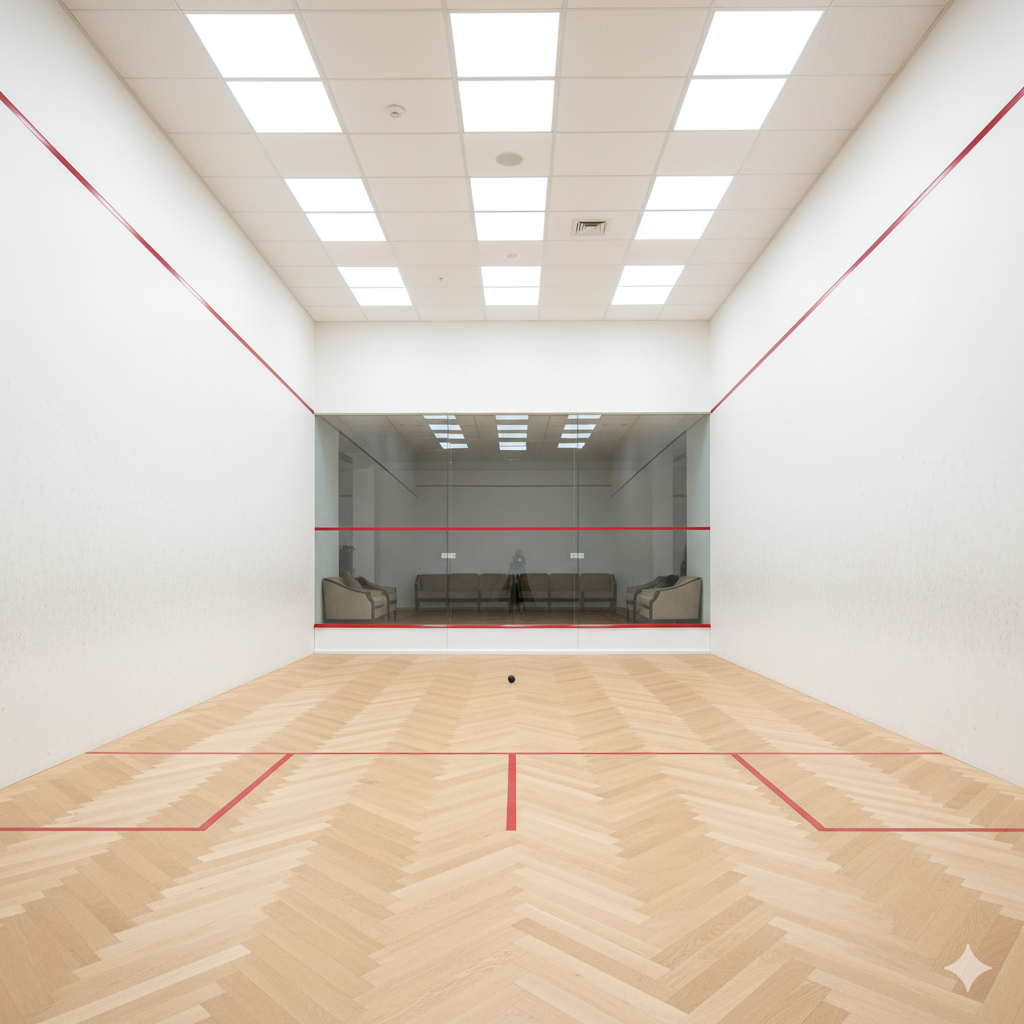
3. Glass-Back Walls:
- Used on the rear side for visibility and aesthetics.
- Made of 12mm toughened safety glass with stainless- steel fittings.
- Adds a modern touch and improves spectator experience.
MSG Sports Infra offers both plaster and glass wall systems designed to meet exact rebound and durability standards.
🪵 Step 3: Flooring Systems
The floor must provide excellent traction, resilience, and shock absorption. Traditionally, squash courts use Solid hardwood for its natural grip and elasticity.
Preferred Flooring Options:
- Canadian Maple Wood:
- Superior bounce and wear resistance.
- Even surface with micro-cushion for player comfort.
- Engineered Wood Flooring:
- Offers Stability against humidity and temperature fluctuations.
- Easier to install and maintain than solid wood.
Each floor is laid over a sprung understructure (elastic subflooring system) that absorbs impact, reducing player fatigue and joint injuries.
At MSG Sports Infra, our installation teams use WSF- compliant wooden flooring systems – ensuring every court performs to international play standards.
💡 Step 4: Lighting & Ventilation
Proper lighting ensures visibility and safety during play.
- Recommended: LED fixtures with uniform illumination (500 lux) and no glare/reflection.
- Avoid placing lights directly above or behind players’ eye levels.
- Include adequate ventilation or air conditioning to maintain consistent temperature and humidity.
⚙️ Step 5: Line Markings & Finishing Touches
Final markings are painted using non-glare white or red paint, depending on wall color. Ensure precision placement for service line, outline, and tin area.
Other finishing features include:
- Door flush with wall surface.
- Protective corner covers.
- Wall padding for safety (optional).
🧽 Step 6: Maintenance & Care
To keep the court performing at its best:
- Sweep and mop the floor daily (avoid wet mops).
- Sand and refinish wooden floors every 3 – 4 years.
- Repaint lines periodically.
- Inspect glass walls and fittings regularly.
Proper maintenance can extend the life of your squash court by over a decade.
🌟 Why Choose a Professional Installer
Building a squash court is a specialized task – requiring knowledge of acoustics, wall rebound, flooring elasticity, and humidity control. Partnering with an experienced sports infrastructure company ensures compliance, safety, and precision.
MSG Sports Infra combines advanced materials, technical know – how, and years of on-ground experience to deliver world- class squash courts for schools, fitness clubs, and professional facilities across India.
🤔 Frequently Asked Questions (FAQs)
Q1. What is the ideal flooring for a squash court?
Hardwood flooring like maple with a sprung understructure is ideal. It offers excellent traction, shock absorption, and consistent bounce.
Q2. Can I use synthetic flooring for squash?
While possible, synthetic floors generally don’t meet WSF standards for competitive play. They’re better suited for multipurpose courts or training areas.
Q3. What’s the average cost to build a squash court in India?
Depending on materials (plaster vs panel walls, wood vs synthetic flooring, lighting, glass walls), the cost typically ranges from Rs. 18 – 25 lakhs per court (as of 2025).
Q4. How long does construction take?
A standard square court takes 4-6 weeks to complete, depending on site readiness and wall type.
Q5. How often should Floor be sanded or maintained?
Every 3-4 Years for resurfacing, with daily dust cleaning and periodic inspections.
Q6. What type of wall finish is best for a squash court?
A fine plaster finish or high – density panel system is ideal. Both provide smooth, hard surfaces with uniform ball rebound. The finish must be non- reflective and easy to repair.
Q7. Can a squash court be built outdoors?
Traditional squash courts are indoor facilities due to lighting and climate control requirements. However, outdoor courts with weatherproof panels and glass backs are now possible using advanced materials – though they require more maintenance.
Q8. What are the lighting requirement for a squash court?
According to WSF standards, lighting should provide at least 500 lux evenly across the court with minimal glare. LED lights are most preferred for their brightness, efficiency, and longevity.
Q9. How long does a squash court floor last?
With regular care and proper humidity control, a well- installed hardwood floor can last 15-20 years or more, especially when maintained by sanding and refinishing every few years.
Q10. What kind of glass is used for the back wall?
Squash courts use 12mm toughened safety glass fixed with stainless steel fittings. It provides durability, impact resistance, and clear visibility for spectators.
Q11. How much space is required to build a square court?
Including surrounding buffer zones, you’ll need a space of roughly 10.5m x 7.5m x 6m height. Additional space may be required for ventilation ducts, lighting, and spectator seating.
Q12. Can an old room be converted into a squash court?
Yes, but only if the dimensions, ceiling height, and wall structure allow it. Retrofitting requires precise wall alignment and flooring adjustments- it’s best handled by a professional sports infra team.
Q13. What maintenance mistakes should be avoided?
- Using excessive water on wooden floors.
- Ignoring humidity control.
- Repainting lines with glossy paint.
Q14. Can I install a viewing gallery or seating?
Yes- a glass-back wall allows spectator viewing from behind. You can integrate raised seating or side benches, depending on available space and safety clearance.
Q15. How do I ensure my squash court meets WSF Standards?
Hire an experienced sports infra partner who WSF – approved guidelines for wall hardness, floor resilience, and marking dimensions. Certification and testing can be done post – installation if needed.
🏁 Conclusion
A properly built squash court combines Precision, Performance, and Durability – ensuring that every bounce, rally, and match feels consistent.
By investing in the right materials and expert craftsmanship, you’ll create a facility that meets international standards and delivers years of value.
MSG Sports Infra has been helping institutions across India bring their sports infrastructure vision to life – from squash courts to multi – sport complexes. To explore customized solutions or request a consultation, feel free to reach out to our team.

Proudly powered by MSG Sports Infra