
Avoid costly errors in sports flooring installation. Discover the top 10 sports flooring mistakes, expert prevention strategies, comparison insights, and compliance guidance for safe, durable, and high-performance courts.
🏗️ Introduction: Why Sports Flooring Decisions Matter
Sports flooring directly affects:
- 🦵Athlete safety and injury prevention.
- ⚡Performance consistency.
- 🏢 Facility durability.
- 💰 Long-term return on investment.
- ⚖️ Legal risk management.
A poor flooring decision can lead to surface failure within 2-3 years, unexpected resurfacing costs, and even liability claims due to player injuries.
This comprehensive guide explains the 10 most common mistakes in sports flooring projects and how professional planning can prevent them.
🚫 1. Selecting Flooring Without Sport-Specific Analysis
Each sport has different mechanical and performance demands.
| Sports | Key Requirement |
| Basketball | High shock absorption + consistent ball rebound |
| Badminton | Anti-skid smooth finish |
| Volleyball | Vertical shock absorption |
| Tennis | Controlled ball pace + UV resistance |
Installing incorrect flooring leads to:
- Reduced athlete performance
- Higher injury rates
- Premature wear
✅ How to Avoid:
Conduct a usage analysis report before selection. Identify:
- Primary sport
- Secondary sports
- Daily usage hours
- Level of competition (school, academy, professional)

🚫 2. Ignoring Subfloor Engineering
Many failures originate from poor base preparation.
Common subfloor issues:
- Improper curing of concrete.
- Moisture seepage.
- Uneven leveling.
- Weak compaction (outdoor courts)
Moisture trapped under indoor flooring can cause:
- Warping
- Adhesive failure
- Surface bubbling
✅How to Avoid:
- Perform moisture vapor emission tests.
- Ensure concrete curing (minimum 28 days)
- Verify slope (1:100 recommended for outdoor)
- Install vapor barriers where required
Subfloor engineering determines long-term structural stability.
🚫 3. Choosing Low Cost Over Lifecycle Value 💰
Initial low pricing often results in:
- Early resurfacing (within 3-5 years)
- Increased maintenance
- Reduced shock absorption
- Color fading
Lifecycle Cost Example:
| Flooring Type | Initial Cost | 10-year Maintenance Cost | Total Lifecycle Value |
| Low-grade Acrylic | Low | High (Frequent repairs) | Expensive long-term |
| Premium Acrylic System | Medium | Low | Cost-efficient |
| Wooden Sports Flooring | High | Moderate | High ROI |
✅ Avoidance Strategy:
Evaluate:
- Warranty terms
- Resurfacing cycle
- Manufacturer reputation
- Performance certifications
🚫 4. Ignoring Climate & Environmental Factors🌡️
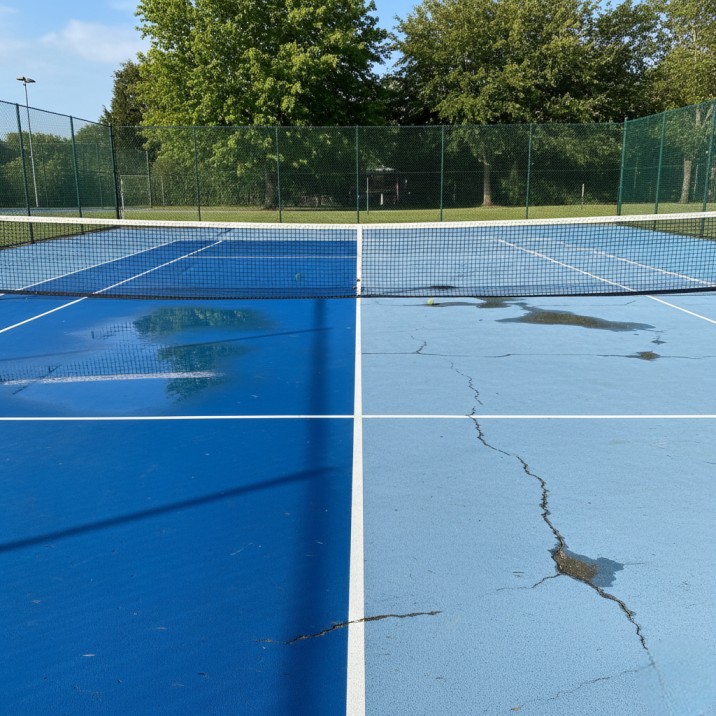
In regions with high heat, humidity, or heavy rainfall, material performance varies significantly.
Environmental risks:
- UV degradation
- Thermal expansion cracks
- Water stagnation
- Mold growth
✅ Professional Recommendation:
- Use UV-resistant coatings.
- Ensure proper drainage channels
- Install thermal expansion joints
- Choose EPDM for extreme conditions
Climate compatibility increases lifespan by up to 40%.
🚫 5. Poor Installation Practices
Even premium systems fail due to:
- Improper adhesive ratios.
- Incorrect layer thickness.
- Insufficient curing time.
- Inaccurate line marking.
✅ Avoid:
- Hire experienced installation teams.
- Conduct quality inspections.
- Maintain documented installation reports.
- Follow manufactures technical specifications.

🚫 6. Neglecting Safety & Compliance ⚖️
Facility operators have legal responsibility for safe playing surfaces.
Non-compliance risks:
- Player injury claims.
- Insurance disputes.
- Legal liability exposure.
Key performance factors:
- Slip resistance
- Shock absorption
- Ball rebound consistency
- Surface friction levels
✅ Prevention:
Ensure flooring aligns with recognized performance benchmarks applicable to your sport category.
🚫 7. No Maintenance Strategy 🧹
Sports flooring requires structured maintenance.
Indoor Courts:
- Dry mopping daily
- Neutral cleaners only
- Periodic refinishing
Outdoor Courts:
- Pressure wash (controlled pressure)
- Crack filling
- Surface recoating (every 4-6 years)
Preventing maintenance extends life significantly.
🚫 8. Ignoring Multi-Sport Planning
Poor planning results in:
- Overlapping lines
- Surface incompatibility
- Poor traction balance
✅ Solution:
Install modular or layered systems designed for multi-use environments.
🚫 9. Poor Drainage Planning (Outdoor Facilities)🌧️
Standing water damages acrylic systems and weakens sub-base.
✅ Prevention:
- 1% court slope
- Peripheral drainage
- Porous asphalt or concrete base (if required)
🚫 10. No Future-Proofing Strategy
Facilities evolve with time.
Smart Planning Includes:
- Modular repair systems
- Resurfacing-friendly layers
- Expandable court designs
📊Professional Comparison Table
| Feature | Wooden Flooring | Acrylic Flooring | EPDM Flooring | Synthetic Turf |
| Indoor Use | Yes | Limited | No | No |
| Outdoor Use | No | Yes | Yes | Yes |
| Shock Absorption | High | Medium | High | Medium |
| Weather Resistance | Low | High | High | High |
| Resurfacing Possible | Yes | Yes | Limited | Limited |
| Ideal For | Basketball | Tennis, Multi-sport | Play areas | Football |
🧠 Strategic Takeaways
✔️ Conduct sport-specific analysis.
✔️ Never compromise subfloor preparation.
✔️ Evaluate lifecycle subfloor preparation.
✔️ Consider climate adaptation.
✔️ Ensure safety compliance.
✔️ Implement preventive maintenance
❓Frequently Asked Questions
1.What is the most durable sports flooring?
Ans:- Durability depends on usage and environment; premium systems last 8-25 years.
2. How often should acrylic courts be resurfaced?
Ans:- Typically every 4-6 years.
3. Is wooden flooring suitable for humid regions?
Ans:- Requires moisture control systems.
4. What causes bubbling in sports flooring?
Ans:- Moisture or improper adhesive bonding.
5. Does sports flooring reduce injuries?
Ans:- Yes, proper shock absorption reduces joint stress.
6. Is EPDM waterproof ?
Ans:- It is water-resistant but requires proper base.
7. What Slope is required for outdoor courts?
Ans:- Approx. 1% for proper drainage.
8. Can flooring be customized with branding?
Ans:- Yes.
9. How long does installation take?
Ans:- Depends on system type and area size.
10. What is the ideal thickness for acrylic flooring?
Ans:- Layered system varies based on usage.
11. Can damaged areas be repaired?
Ans:- Yes, localized repairs are possible.
12. What is lifecycle cost?
Ans:- Total cost over 10-15 years including maintenance.
13.Do indoor courts require ventilation?
Ans:- Yes, to control moisutre.
14. Is synthetic turf good for heavy use?
Ans:- Yes, if professionally installed.
15. What is the safest flooring for schools?
Ans:- Shock-absorbing systems like EPDM or wooden flooring.
16. Does poor flooring affect performance?
Ans:- Yes, it impacts traction and bounce.
17. Can resurfacing restore performance ?
Ans:- Yes, if base structure is intact.
18. What maintenance chemicals should be avoided?
Ans:- Harsh acidic cleaners.
19. Does climate affect flooring lifespan?
Ans:- Yes, significantly.
20. Should flooring comply with sports authority standards?
Ans:- Yes, to ensure performance and safety.
🏁 Conclusion
Avoiding these common sports flooring mistakes ensures:
- 🛡️Athlete protection
- 🏆Performance enhancement
- 💰Long-term cost savings
- ⚖️ Legal risk reduction
- 🏗️ Infrastructure durability
Strategic planning, quality materials, and professional installation are the foundation of every successful sports flooring projects.