
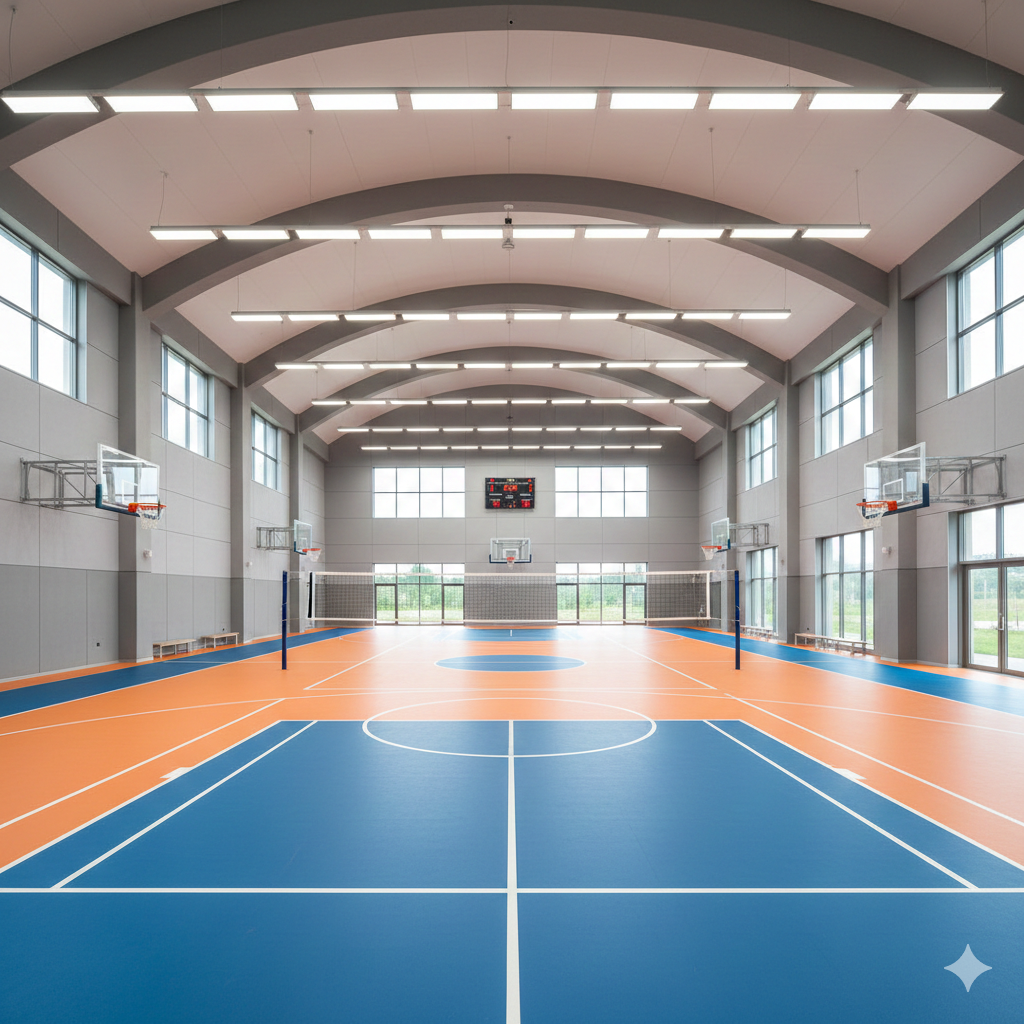
Designing a high-performance multi-sport court is not just about marking lines and installing nets – the flooring defines safety, performance, durability, and long-term cost. Whether you are building a facility for a school, sports, sports academy, club, residential complex, or government project, selecting the right sports flooring is one of the most critical decisions.
A multi-sport court must support different movement patterns:
- Fast lateral movement (badminton, basketball)
- Jump impact and landing safety (volleyball)
- Ball bounce consistency
- Slip resistance and shock absorption
- Easy maintenance and long service life
In this comprehensive guide, we’ll explore:
✔️ Best flooring types for multi-sports courts
✔️ Performance comparison
✔️ Indoor vs outdoor considerations
✔️ Cost and maintenance insights
✔️ Expert FAQs
🎯Why Flooring Matters in a Multi-Sport Court
A multi-sport court hosts multiple activities on the same surface. Poor flooring selection can result in:
❌ Increased injury risk
❌ Slippery or inconsistent traction
❌ Uneven ball bounce
❌ High maintenance costs
❌ Faster surface wear
High-quality sports flooring provides:
✅ Shock absorption to reduce joint stress
✅ Controlled friction for safe movement
✅ Uniform ball rebound
✅ Moisture and wear resistance
✅ Compliance with international sports standards
🧱 Most Popular Flooring Options for Multi-Sport Courts
Let’s examine the most trusted and widely used flooring systems.
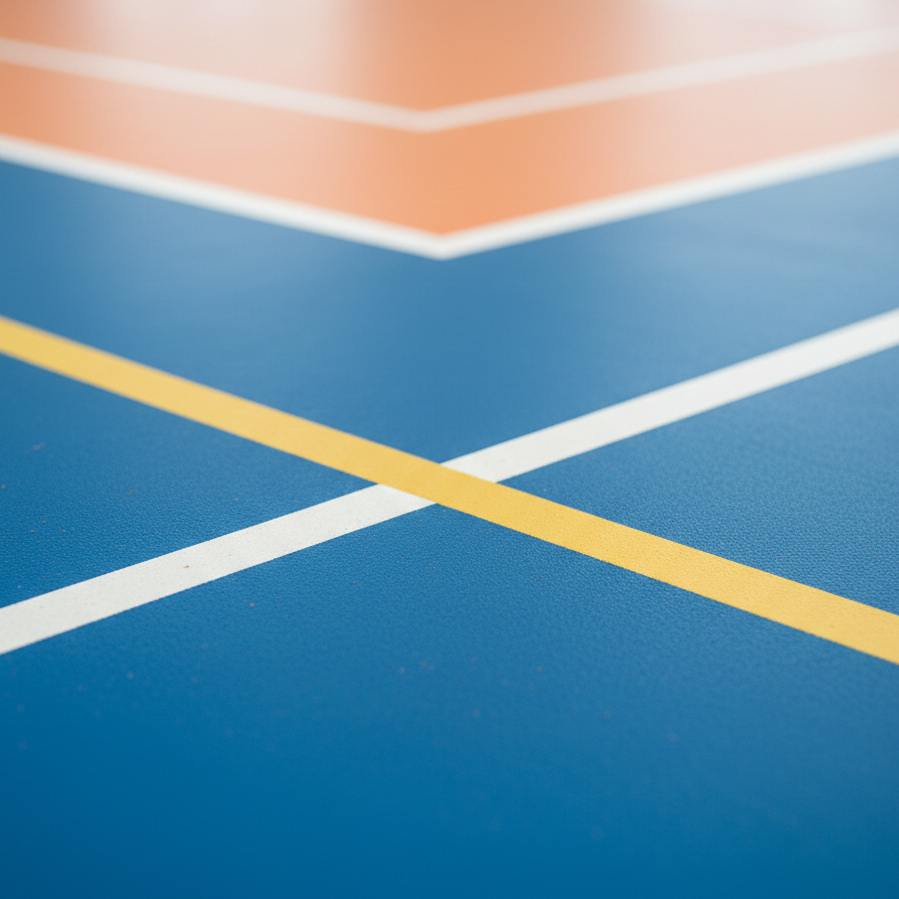
🥇 1.PU (Polyurethane) Sports Flooring
PU flooring is one of the most preferred solutions for both indoor and outdoor multi-sport courts.
Key Benefits
- Excellent shock absorption and comfort
- Seamless surface reduces dust and bacteria
- High durability and abrasion resistance
- Weather-resistant (UV, rain, temperature variation)
- Suitable for basketball, badminton, volleyball, handball.
Best Applications
- Indoor sports halls
- School and academy courts
- Outdoor synthetic courts
Limitations
- Higher initial cost than basic surfaces
- Requires professional installation
🥈 2. PVC Vinyl Sports Flooring
PVC flooring is widely used for indoor multipurpose halls and gymnasiums.
Key Benefits
- Comfortable underfoot
- Good slip resistance
- Easy installation using rolls or tiles
- Attractive surface designs
Best Applications
- Indoor badminton halls
- Training centers
- Community sports halls
Limitations
- Not ideal for heavy outdoor exposure
- Can wear faster in high-impact zones
🥉 3. Modular Interlocking Sports Tiles (PP / Rubber)
Modular tiles are popular for fast installation and outdoor versatility.
Key Benefits
- Quick installation and replacement
- Good drainage for outdoor courts
- Low maintenance
- Weather resistant
Best Applications
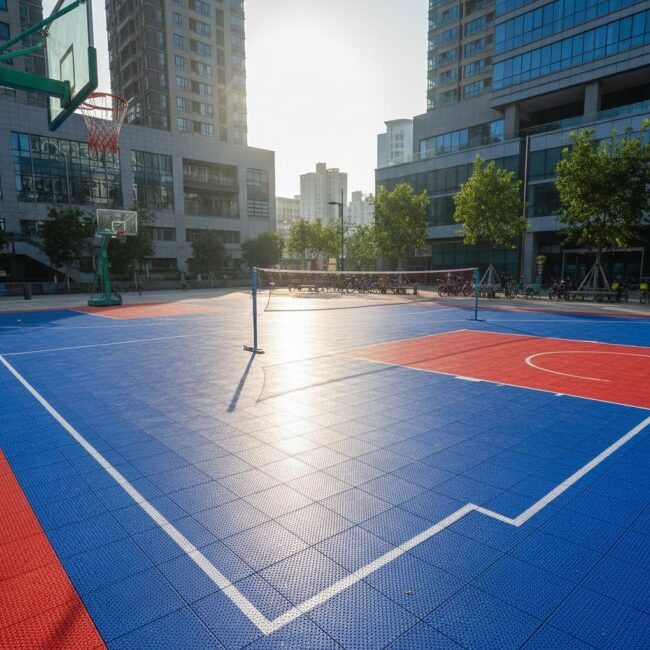
- Outdoor basketball courts
- Rooftop courts
- Recreational spaces
Limitations
- Slightly harder surface feel
- May generate more noise indoors
🪵 4. Wooden Sports Flooring (Maple / Engineered Wood)
Wood flooring remains the premium choice for professional indoor arenas.
Key Benefits
- Excellent ball response
- High aesthetics
- Proven professional performance
Best Applications
- Professional indoor basketball courts
- Stadiums
Limitations
- High cost
- Sensitive to moisture
- Requires regular polishing and care
📊 Comparison Table – Multi-Sport Flooring Options
| Feature | PU Flooring | PVC Vinyl | Modular Tiles | Wooden Flooring |
| Shock Absorption | ⭐⭐⭐⭐⭐ | ⭐⭐⭐⭐ | ⭐⭐⭐ | ⭐⭐⭐⭐⭐ |
| Slip Resistance | ⭐⭐⭐⭐ | ⭐⭐⭐⭐ | ⭐⭐⭐⭐ | ⭐⭐⭐ |
| Durability | ⭐⭐⭐⭐⭐ | ⭐⭐⭐ | ⭐⭐⭐⭐ | ⭐⭐⭐⭐ |
| Indoor Use | Excellent | Excellent | Good | Excellent |
| Outdoor Use | Excellent | Not Recommended | Excellent | Not Suitable |
| Maintenance | Low | Low-Medium | Very Low | High |
| Installation Cost | Medium-High | Medium | Medium | High |
| Multi-Sport Suitability | Excellent | Very Good | Good | Limited |
(Ratings are indicative based on industry experience and typical performance.)
🏟️ Indoor vs Outdoor Multi-Sport Court Flooring
🏠 Indoor Courts
Recommended:
- PU Flooring
- PVC Vinyl
- Wooden Sports Flooring
Key requirements:
- Shock absorption
- Controlled slip resistance
- Noise control
- Hygienic surface
🌤️ Outdoor Courts
Recommended:
- PU Synthetic Systems
- Modular Interlocking Tiles
Key Requirements:
- UV Stability
- Drainage
- Temperature resistance
- Anti-slip wet performance
💰 Cost Considerations (Practical Insight)
While pricing varies by thickness, brand, base preparation, and location, consider:
- Initial material cost
- Installation quality
- Maintenance expense
- Expected lifespan
- Downtime for repairs
A slightly higher upfront investment often results in lower long-term operating costs.
🧹 Maintenance & Longevity Tips
✔️ Daily dry mopping or sweeping
✔️ Weekly damp cleaning with neutral cleaners
✔️ Avoid harsh chemicals
✔️Inspect joints and edges periodically
✔️Protect from sharp equipment
✔️Maintain proper indoor ventilation
Proper maintenance can extend surface life by several years.
🛡️Safety & Standards
High-quality sports flooring should meet:
- Slip resistance norms
- Shock absorption guidelines
- Surface flatness standards
- Fire safety requirements (indoor)
- Environmental compliance
Always work with certified installers and tested materials.
🌟 Final Recommendation
For most modern multi-sports facilities:
👉PU Sports Flooring offers the best balance of safety, durability, multi-sport compatibility, and long-term value.
👉 Modular Tiles are excellent for fast outdoor installations and school halls.
👉Wood Flooring Suits premium professional venues.
❓Frequently Asked Questions (FAQs)
1.What is the best flooring for a multi-sports court?
Ans: – PU sports flooring is generally the best all-round solution.
2.Can one floor support basketball and badminton together?
Ans:- Yes, PU and PVC systems supports both sports safety.
3. Is modular flooring good for outdoor courts?
Ans:- Yes, modular tiles handle weather and drainage well.
4. How long does PU flooring last?
Ans:- Typically 8-12 years with proper maintenance.
5. Is wooden flooring suitable for outdoor use?
Ans:- No, wood is strictly for indoor environments.
6. Which flooring offers the best shock absorption?
Ans:- PU and wooden sports flooring.
7. What is the easiest flooring to maintain?
Ans:- Modular tiles and PU flooring.
8. Can multi-sport courts have multiple line markings?
Ans:- Yes, professional coating allow clear multi-line layouts.
9. Is PVC flooring slippery?
Ans:- No, quality PVC has controlled anti-slip textures.
10. How long does installation usually take?
Ans:- From a few days(tiles) to 1-2 weeks (PU systems).
11. Can these floors handle heavy foot traffic?
Ans:- Yes, when designed for sports-grade usage.
12. Are these floors eco-friendly?
Ans:- Many modern systems use low-VOC and recyclable materials.
13. Does flooring affect ball bounce?
Ans:- Yes, surface elasticity influences rebound consistency.
14. Can damaged sections be repaired?
Ans:- Tiles can be replaced; PU may require patch repair.
15. Which flooring is best for schools?
Ans:- PU or PVC depending on budget and usage.
16. Are these floors safe for children?
Ans:- Yes, when installed to sports safety standards.
17. Can outdoor floors handle rain?
Ans:- Yes, PU and tiles are designed for drainage and grip.
18. How often should a court be resurfaced?
Ans:- Typically every 6-10 years depending on usage.
📞 Need Expert Guidance?
If you are planning a new multi-sport court or upgrading an existing facility, professional, consultation ensures the best return on investment, safety compliance, and performance longevity.
Proudly powered by MSG Sports Infratek India LLP