
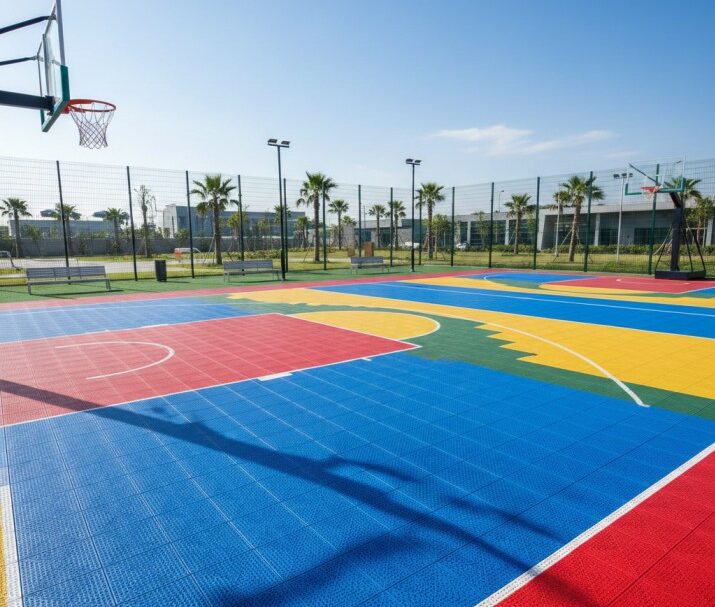
The global sports infrastructure industry is undergoing a major transformation. From schools and academies to professional sports complexes and public recreation spaces, flooring systems are no longer chosen only for cost- performance, durability, safety, speed of installation, and long-term maintenance now play a critical role.
Over the past decade, Modular PP (Polypropylene) Tiles have rapidly emerged as a preferred alternative to traditional sports flooring systems such as acrylic courts, PU flooring, wooden floors, and concrete-based solutions.
This shift is not a trend driven by aesthetics alone – it is rooted in engineering efficiency, material science, Scalability, and lifecycle performance. This article explores why modular PP tiles are replacing traditional sports flooring systems, from a manufacturer and industry expert’s perspective.
Understanding Modular PP Tiles Sports Flooring 🧩
Modular PP tiles are interlocking sports flooring tiles manufactured using high-grade polypropylene polymers. These tiles are designed specifically for sports performance and safety, incorporating:
- Load-bearing structural ribs
- Anti-slip textured surfaces
- Controlled ball bounce properties
- Shock absorption through sub-structure design
- Integrated drainage and ventilation channels
Unlike traditional monolithic flooring systems, PP tiles courts are assembled tile by tile, allowing precision installation and modular flexibility.
Limitations of Traditional Sports Flooring Systems ⚠️
Before understanding why PP tiles are gaining dominance, it’s important to recognize the challenges associated with traditional sports flooring:
Acrylic Flooring
- Requires extensive surface preparation
- Sensitive to base quality and weather conditions
- Cracks over time due to substrate movement
- Long curing time
PU(Polyurethane) Flooring
- Higher material and installation costs
- Complex application process
- Difficult to repair once damaged
- Limited suitability for outdoor environments
Wooden Sports Floors
- High maintenance requirements
- Moisture sensitivity
- Expensive installation and upkeep
- Mostly limited to indoor use
Concrete / Cement Courts
- Hard impact surface (higher injury risk)
- Poor shock absorption
- Inconsistent ball bounce
- Surface deterioration over time
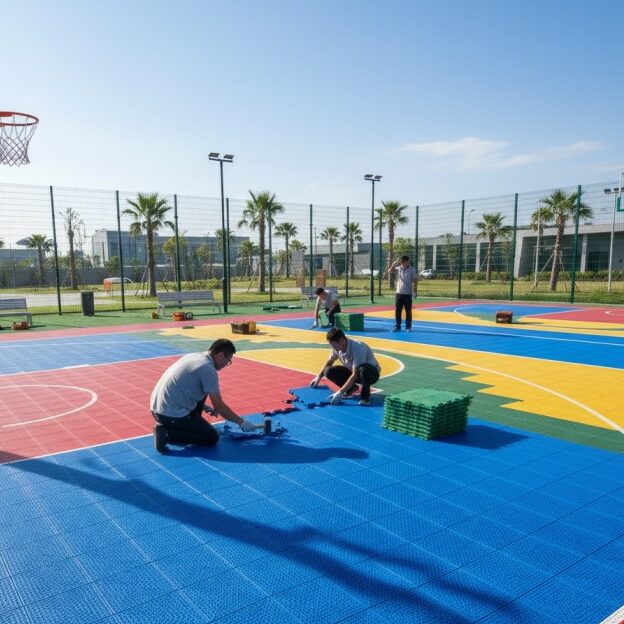
Key Reasons Modular PP Tiles Are Replacing Traditional Flooring System 🚀
1.Superior Structural Engineering & Load Distribution
Modular PP tiles are designed with reinforced under-structures that evenly distribute player load and impact forces. This reduces stress on joints and enhances athlete safety compared to rigid surfaces.
2. Shock Absorption & Player Safety 🦵
Unlike hard concrete or thin acrylic layers, PP tiles provide measured vertical deformation, helping to:
- Reduce impact stress
- Lower injury risks
- Improve playing comfort
This makes them ideal for schools, academies, and high-usage courts.
3. Consistent Ball Bounce & Surface Performance ⚽🏀
Precision-molded tile surfaces ensure:
- Uniform ball rebound
- Predictable player movement
- Reliable sports performance
Consistency is often difficult to maintain in traditional systems due to surface wear and cracking.
4. Fast & Clean Installation ⏱️
One of the strongest advantages of modular PP tiles is installation speed:
- No curing time
- No wet chemicals
- Minimal site disruption
Large courts can be installed and made Playable within a very short timeframe.
5. All-Weather Outdoor Compatibility 🌦️
PP tiles are engineered with:
- UV stabilization
- Thermal resistance
- Integrated drainage channels
This allows courts to perform reliably in rain, heat, and varying climatic conditions, unlike acrylic or PU systems.
6. Low Maintenance & Easy Repair🔧
If a section of a traditional floor fails, the entire surface often needs repair.
With PP tiles:
- Individual tiles can be replaced
- No visible patchwork
- Minimal downtime
This modular repair capability significantly reduces lifecycle costs.
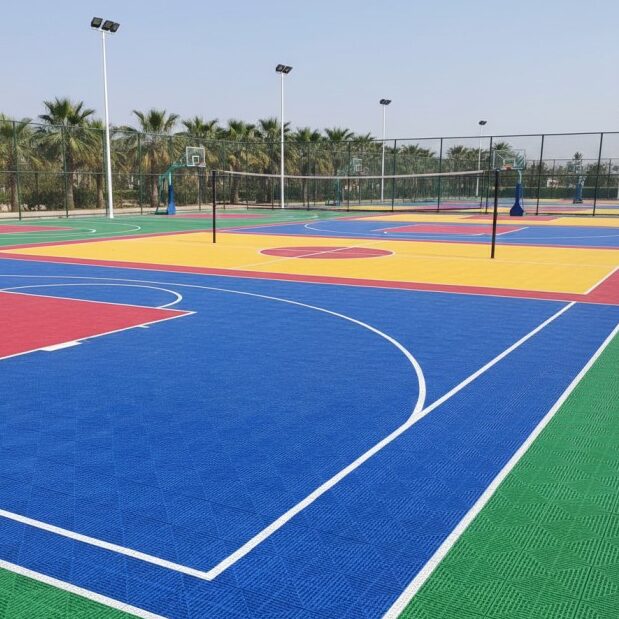
7. Scalability & Multi-Sport Flexibility 🎯
PP tile systems support:
- Basketball
- Badminton
- Futsal
- Volleyball
- Pickleball
- Multi-sport courts
Court layouts, markings, and colors can be customized without altering structural integrity.
Comparison Table: Modular PP Tiles Vs Traditional Sports Flooring
| Parameter | Modular PP Tiles | Acrylic Flooring | PU Flooring | Concrete |
| Installation Time | Very Fast | Slow | Slow | Moderate |
| Shock Absorption | High | Low | Medium | Very Low |
| Maintenance | Low | Medium | Medium | High |
| Outdoor Suitability | Excellent | Weather Sensitive | Limited | Moderate |
| Repairability | Easy (Tile Replacement) | Difficult | Difficult | Very Difficult |
| Ball Bounce Consistency | High | Medium | Medium | Low |
| Lifecycle Cost | Optimized | Moderate | High | High |
Sustainability & Long-Term Value 🌱
Modern PP tiles are:
- Long-lasting
- Recyclable at end-of-life
- Low waste during installation
- Designed for extended usage cycles
Their durability and modular nature significantly reduce resource consumption and operational waste, making them a responsible choice for modern sports infrastructure.
Why Sports Infrastructure Developers Prefer Modular PP Tiles 🏗️
From a company and industry standpoint, modular PP tiles offers:
- Faster project execution
- Predictable performance
- Reduced post-installation issues
- Lower long-term maintenance costs
- High client satisfaction
These advantages align perfectly with the demands of government projects, educational institutions, sports academies, and urban recreational developments.
📌 Frequently Asked Questions (FAQs)
1.What are sports PP tiles made of?
Ans:- High-grade polypropylene polymer designed for sports performance.
2. Are PP tiles suitable for outdoor courts?
Ans:- Yes, they are specifically engineered for outdoor and all-weather use.
3. Do PP tiles provide shock absorption?
Ans:- Yes, their sub-structure design offers effective impact absorption.
4. Can PP tiles be used indoors?
Ans:- Yes, they are suitable for both indoor and outdoor applications.
5. How long do modular PP tiles last?
Ans:- With proper installation, they offer long-term durability under heavy use.
6. Are PP tiles slippery?
Ans:- No, they feature anti-slip textured surfaces.
7. Can damaged tiles be replaced individually?
Ans:- Yes, this is a key advantage of modular systems.
8. Are PP tiles suitable for schools?
Ans:- Absolutely, due to safety, durability, and low maintenance.
9. Do PP tiles support multi-sport usage?
Ans:- Yes, they are ideal for multi-sport courts.
10. Is drainage an issue during rain?
Ans:- No, integrated drainage channels prevent water accumulation.
11. Are PP tiles better than acrylic courts?
Ans:- In terms of maintenance, installation speed, and modularity- yes.
12. Do PP tiles fade under sunlight?
Ans:- UV-stabilized tiles resist color fading.
13. Is base preparation required?
Ans:- A flat and stable base is required, but no complex layering.
14. Can court markings be customized?
Ans:- Yes, colors and layouts are fully customizable.
15. Are PP tiles environmentally responsible?
Ans:- Yes, due to recyclability and reduced waste.
16. Do PP tiles crack over time?
Ans:- They are resistant to cracking unlike rigid flooring systems.
17. Are PP tiles suitable for high-traffic areas?
Ans:- Yes, they are designed for heavy usage.
18. Can PP tiles be relocated?
Ans:- Yes, tiles can be dismantled and reinstalled if needed.
Conclusion 🎯
The rise of modular PP tile sports flooring is not accidental – it is result of engineering efficiency, performance reliability, and long-term value. As sports infrastructure continues to evolves, traditional flooring systems are giving way to modular solutions that offer flexibility, safety, and scalability.

Proudly powered by MSG Sports Infratek India LLP