
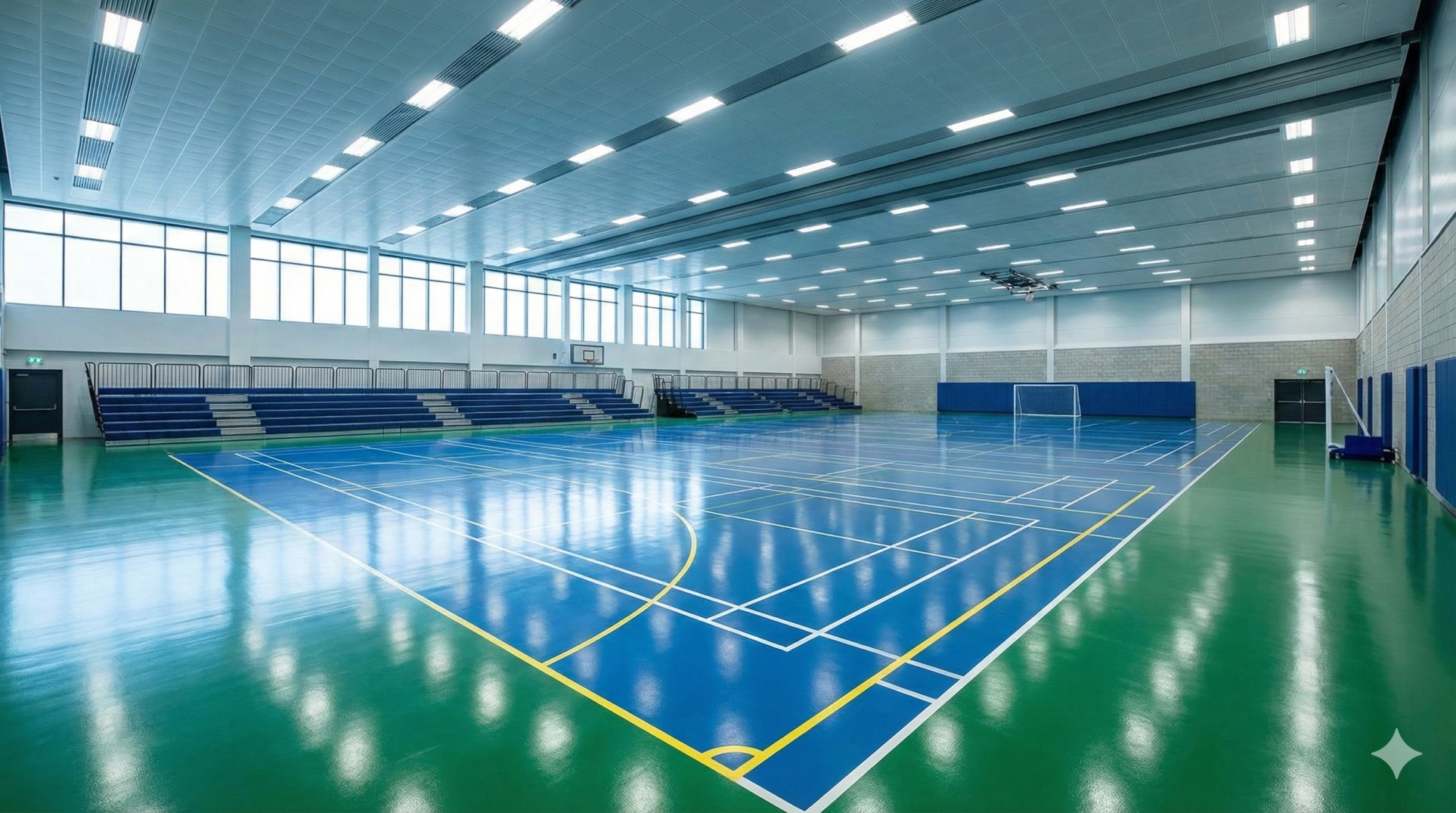
Choosing the right PVC sports flooring for your sports facility is one of the most important decisions you’ll make. Whether you’re building an indoor court, a school gym, a fitness center, or a multipurpose sports arena, the type of flooring you select directly impacts athlete performance, safety, longevity, and operational costs.
PVC flooring has become the top choice for modern sports spaces due to its shock absorption, comfort, high durability, and low maintenance needs. But with so many options available, how do you choose the right one?
This guide covers everything you need to know before making your purchase.
What is PVC Sports Flooring?
PVC (Polyvinyl Chloride) sports flooring is a multi-layer, flexible synthetic flooring solution designed for sports and recreational activities. It typically consists of:
- Wear Layer – protects against scratches & abrasion
- PVC Foam Layer – shock absorption & cushioning
- Reinforcement Layer – Stability & dimensional strength
- Base Layer – firm support and longevity
Its layered structure makes it excellent for indoor courts, gyms, dance studios, badminton halls, basketball courts, and multipurpose facilities.
Key Factors to Consider When Choosing PVC Sports Flooring
1.Identify Your Sport or Facility Type
Different sports have different performance needs. For example:
- Badminton: requires anti-slip flooring with medium cushioning.
- Basketball: needs high shock absorption & ball bounce consistency.
- Gym/fitness: requires higher density for equipment stability.
- Multipurpose halls: need balanced performance for various activities.
Selecting flooring designed for your sport ensures optimal performance and safety.
2. Consider Thickness and Cushioning
PVC sports flooring typically ranges from 3.5 mm to 8 mm.
| Flooring Thickness | Best For | Features |
| 3.5-4.5mm | Schools, multipurpose halls | Medium cushioning, cost-effective |
| 5-6 mm | Badminton, volleyball, table tennis | Good grip & comfort |
| 7-8mm | Basketball, futsal, professional courts | Maximum shock absorption & durability |
Thicker flooring offers better cushioning, ideal for high-impact sports.
3. Surface Texture and Grip Level
A non-slip, textured surface helps prevent injuries. Make sure the following provides:
- Anti-slip rating (R9-R11 recommended)
- Good friction even when slightly wet
- Smooth but firm grip for fast movements
This is especially critical for sports like badminton, volleyball, and handball.
4. Shock Absorption & Player Safety
High-quality PVC sports flooring should have at least 20-25% shock absorption, while premium options may offer up to 40% or more.
Benefits include:
- Reduced strain on joints
- Lower risk of injuries
- Enhanced comfort during play
Always check the technical sheet for shock-absorption values.
5. Durability and Wear Resistance
If your facility experiences heavy foot traffic, choose flooring with:
- A stronger wear layer (0.5 mm to 1.5 mm)
- UV- Protection coating
- Scratch – resistant surface
- Anti-dent properties
Durable flooring reduces long-term maintenance costs.
6. Ease of Installation
PVC sports flooring can be:
- Roll-based (most common, seamless, long-lasting)
- Tile-based (easy to replace & install)
Roll-based installation offers better performance and aesthetics for professional courts.
7. Maintenance Requirements
PVC sports flooring is low maintenance, but choosing high-quality material ensures:
- Easy cleaning
- Stain resistance
- Long life span
Daily sweeping and occasional mopping keep it in top condition.
8. Budget & Warranty
Quality PVC flooring is an investment. Consider:
- Total lifespan
- Warranty period (ideally 5-10 years)
- Maintenance costs
- Installation cost
Higher-quality flooring often provides better long-term value.
FAQ’s
1.What makes PVC sports flooring better than wooden flooring?
PVC is more affordable, easier to maintain, and offers excellent shock absorption compared to wood.
2. How long does PVC sports flooring typically last?
With proper care, it lasts 8-15 years, depending on usage and quality.
3. Is PVC safe for athletes?
Yes. Modern PVC sports flooring is non-toxic, cushioned, and designed to reduce injuries.
4. What thickness is best for badminton courts?
5-6 mm is ideal for badminton facilities.
5. Can PVC flooring be used outdoors?
Only if specifically designed for outdoor use. Regular indoor PVC flooring is not UV-resistant.
6. How do I clean and maintain PVC sports flooring?
Sweep daily and mop with mild cleaning agents. Avoid harsh chemicals.
7. Can heavy gym equipment be used on PVC flooring?
Yes, but choose high-density PVC flooring for gym areas.
8. Does PVC flooring provide good grip?
Absolutely. Quality PVC floors have anti-slip textures suitable for fast sports movements.
9. What is the installation time for PVC sports flooring?
Usually 1-3 days, depending on floor size and preparation required.
10. Is PVC flooring water-resistant?
Yes, it is naturally moisture-resistant and suitable for humid environments.
11. Can PVC sports flooring be customized with court marking?
Yes. Marking can be painted or printed to match any sport.
12. What colors are available for PVC sports flooring?
Many options including wood-tone, blue, green, red, grey, and custom shades.
13. Is PVC sports flooring eco-friendly?
Many manufacturers now produce recyclable and low-VOC PVC flooring.
14. How thick should basketball court PVC flooring be?
7-8 mm for professional bounce and premium cushioning.
15. Does PVC flooring reduce noise?
Yes, its foam backing helps in sound absorption, making it ideal for indoor use.

Proudly powered by MSG Sports Infratek India LLP