
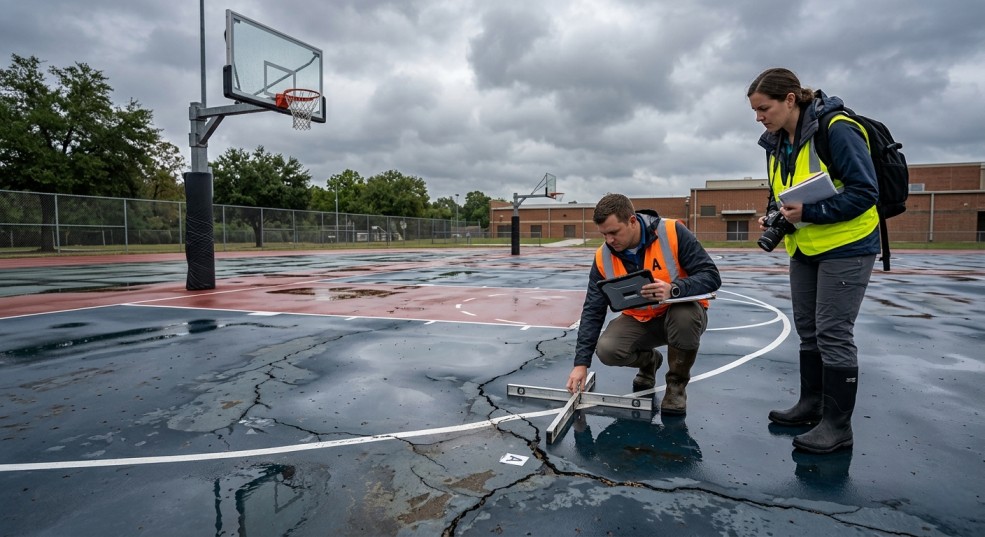
Acrylic sports flooring is one of the most popular surface systems used for basketball courts, tennis courts, tennis courts, multi-purpose courts, and recreational sports facilities. It is known for its durability, weather resistance, vibrant appearance, and relatively low maintenance requirements.
However, many facility owners notice a common issue:
⚠️“Why did my acrylic court develop cracks after heavy rain?”
The reality is that rain itself is usually not the direct cause of cracking. Instead, rainfall often exposes underlying construction, drainage, or structural problems that were already present beneath the surface.
🏀Understanding Acrylic Sports Flooring
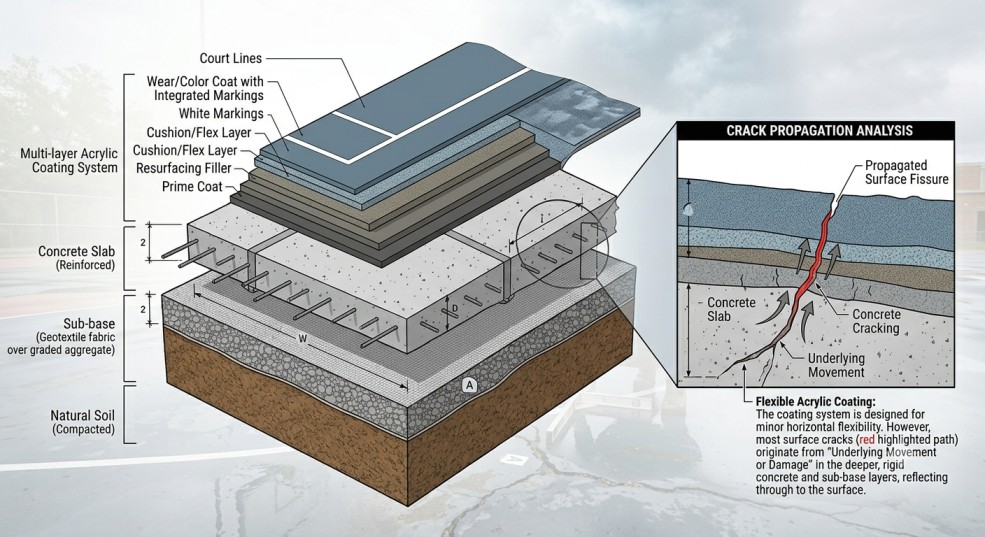
Before discussing cracks, it’s important to understand how an acrylic sports courts is constructed.
A typical acrylic cracks, it’s important to understand how an acrylic sports is constructed.
A typical acrylic court consists of:
✅ Compacted Subgrade
✅ Granular Sub-Base
✅ Concrete or Asphalt Base
✅ Acrylic Resurfacer Layer
✅ Acrylic Color Coatings
✅ Court Markings
🌧️ Does Rain Directly Cause Acrylic Courts Cracks?
This simple answer is:
❌Not usually.
Rainwater does not normally crack a properly designed and constructed acrylic sports courts.
However, rain can:
- Reveal hidden structural issues
- Increase moisture movement
- Expose drainage failures
- Accelerate existing damage
Think of rain as a “stress test” for your court.
If weaknesses already exist, rainfall often makes them visible.
🔍 Main Reasons Acrylic Sports Courts Crack After Rain
1️⃣ Poor Drainage System
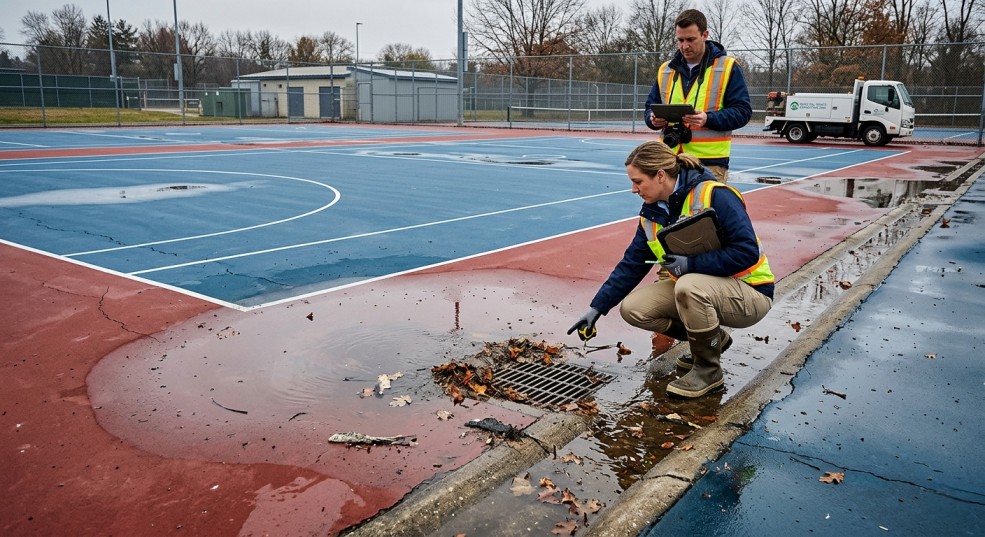
One of the biggest reasons for cracking is water accumulation.
When rainwater cannot drain properly:
💧Water remains on the court surfaces
💧 Water penetrates expansion joints
💧 Moisture reaches the base layers
Over time, the underlying structure weakens and begins to shift.
Warning Signs
- Water puddles remain after 24 hours
- Court edges remain wet
- Moss or algae growth
- Surface discoloration
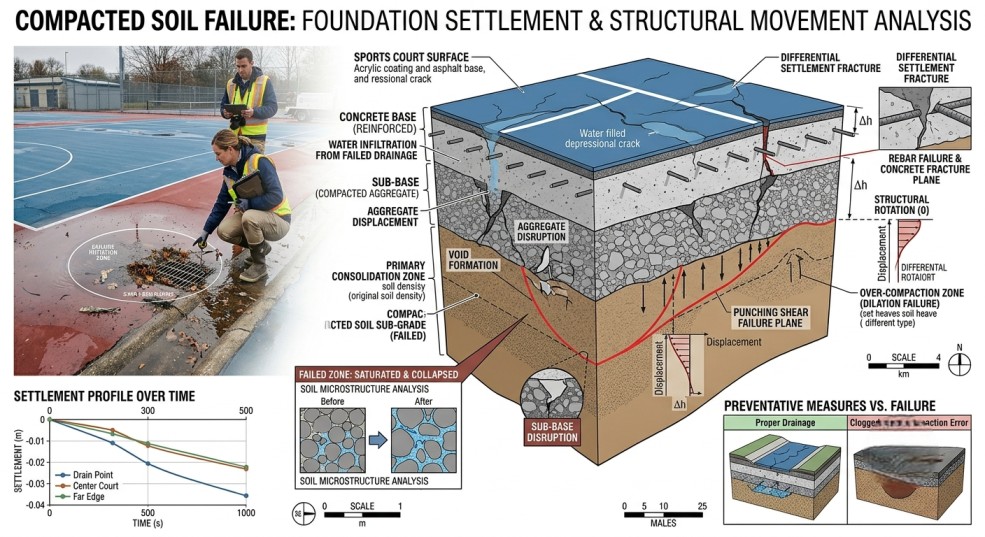
2️⃣Weak or Improper Subgrade Preparation
The foundation below the court is critical.
If soil was not properly compacted during construction:
⚠️ Rainwater can soften the ground.
This may cause:
- Settlement
- Uneven movement
- Surface stress
Eventually, cracks appear in the acrylic surface.
3️⃣ Poor Quality Concrete Base
The acrylic coating follows whatever happens to the concrete below.
If the concrete base develops cracks:
➡️Those cracks often reflect through the acrylic coating.
This phenomenon is called:
Reflective Cracking
Common reasons include:
- Poor concrete mix design
- Inadequate curing
- Low-strength concrete
- Lack of reinforcement
4️⃣Expansion and Contraction Due to Moisture
Concrete naturally expands and contracts.
When heavy rainfall is followed by intense sunlight:
☀️Concrete heats up
🌧️Moisture evaporates
This repeated cycle creates stress within the slab.
Over time:
- Hairline cracks develop
- Existing cracks widen
5️⃣Water Seeping Through Existing Micro-Cracks
Many courts already contain tiny cracks that are difficult to notice.
During rainfall:
💧Water enters these small openings
Repeated wet-dry cycles gradually enlarge them.
What begins as a hairline crack can eventually become a major structural issue.
6️⃣ Absence of Expansion Joints
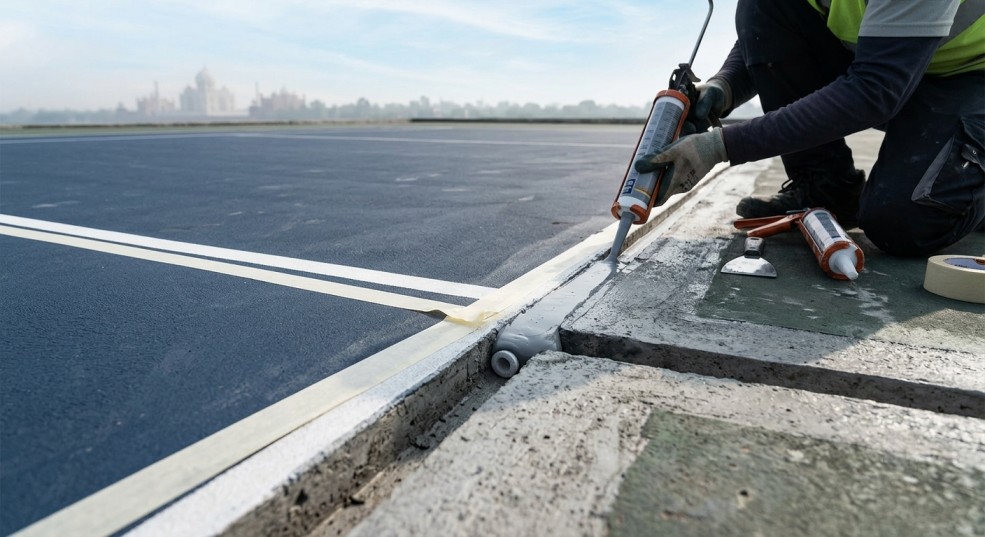
Expansion joints allow concrete to move naturally.
Without proper joints:
- Thermal expansion creates pressure
- Concrete movement becomes restricted
- Cracks develop in random locations
7️⃣Tree Roots and Ground Movement
Many outdoor courts are constructed near landscaped areas.
Tree roots can:
🌳Grow beneath the court
🌳Lift portions of the slab
🌳Create uneven pressure
Rainwater often accelerates this process by softening surrounding soil.
8️⃣ Freeze-Thaw Damage (Relevant in Cold Regions)
Although less common in most parts of India, freeze-thaw cycles are a major cause of cracking globally.
Water enters cracks and freezes.
As water expands during freezing:
❄️ Internal pressure increases
Result:
- Wider cracks
- Surface deterioration
📊Common Causes of Acrylic Court Cracking
| Cause | Severity Level | Likelihood | Prevention Difficulty |
| Poor Drainage 🌧️ | Very High | Very Common | Moderate |
| Weak Subgrade🏗️ | Very High | Common | High |
| Concrete Cracks 🧱 | High | Common | Moderate |
| Water Infiltration💧 | High | Very Common | Low |
| Missing Expansion Joints 📏 | High | Moderate | Moderate |
| Tree Root Damage 🌳 | Medium | Moderate | Moderate |
| Thermal Movement ☀️ | Medium | Common | Low |
🚨 Early Warning Signs You Should Never Ignore
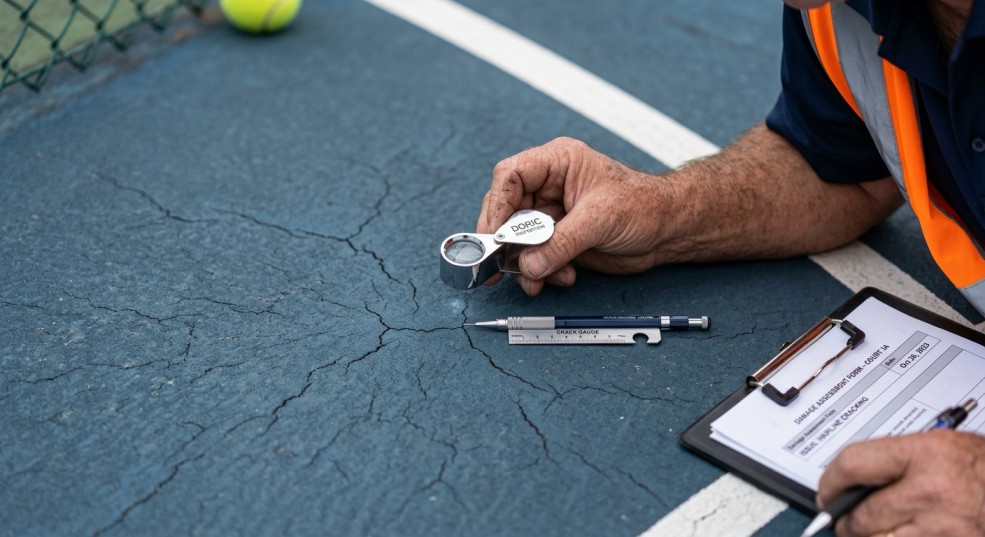
Watch for:
✅Hairline cracks
✅Standing water
✅Surface bubbling
✅Peeling coatings
✅Uneven court areas
✅Color fading around cracks
Addressing these signs early can significantly reduce repair costs.
🛠️How to Prevent Acrylic Sports Court Cracks
✔️Ensure Proper Court Slope
Most outdoor courts require appropriate slope for water drainage.
Proper drainage minimizes standing water.
✔️Use High-Quality Concrete
A strong base reduces structural movement.
Investing in proper concrete work is often more important than choosing premium surface coatings.
✔️Install Effective Drainage Systems
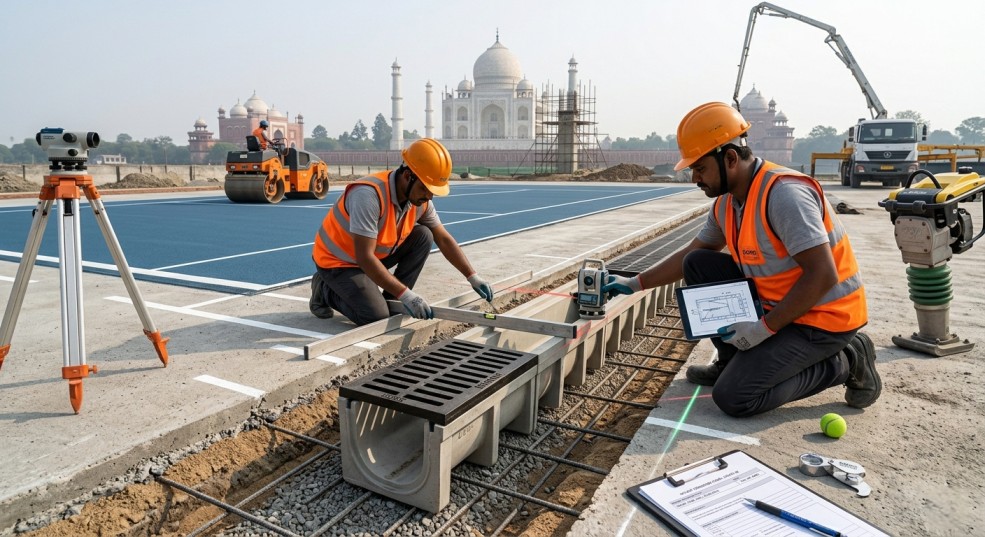
A drainage system should direct water away from the court immediately after rainfall.
✔️Seal Small Cracks Early
Minor cracks often be repaired before becoming larger structural issues.
Early intervention saves money.
✔️Schedule Annual Court Inspections
Professional inspections help identify:
- Surface wear
- Drainage issues
- Structural movement
before major damage occurs.
🔧Repair Options for Acrylic Court Cracks
| Crack Type | Recommended Solution |
| Hairline Cracks | Acrylic crack filler |
| Minor Surface Cracks | Flexible repair system |
| Reflective Concrete Cracks | Structural crack treatment |
| Large Settlement Cracks | Base reconstruction |
| Drainage-Related Cracks | Drainage correction + resurfacing |
🏆 Best Practices for Long-Term Court Durability
✅Proper soil compaction
✅Quality concrete construction
✅Adequate drainage design
✅ Regular inspections
✅ Timely repairs
✅Professional installation standards
Acrylic sports courts can provide years of reliable service when these fundamentals are followed.
❓Frequently Asked Questions
1. Does rain directly crack acrylic courts?
👉 Usually no. Rain exposes underlying structural problems.
2. What is the most common cause of court cracking?
👉Poor drainage and base movement.
3. Can standing water damage acrylic courts?
👉Yes, prolonged water accumulation can accelerate deterioration.
4. What are hairline cracks?
👉 Small surface cracks that may expand over time.
5. Are acrylic courts waterproof?
👉They are water-resistant but not completely waterproof.
6. How soon should cracks be repaired?
👉 As early as possible to prevent expansion.
7. Can cracks affect gameplay?
👉 Yes, they can impact ball bounce and player safety.
8. Is resurfacing enough for all cracks?
👉 No. Structural cracks often require deeper repairs.
9. How long does acrylic court resurfacing last?
👉 It depends on usage, maintenance, and environmental condition.
10. Why does water pool on my court?
👉 Usually due to drainage or slop issues.
11. Can poor soil preparation cause cracking?
👉 Yes, it is one of the leading causes,
12. What is reflective cracking?
👉 Crack from the concrete base appearing through the acrylic surface.
13. Can tree roots damage sports courts?
👉Yes, roots can create upward pressure on slabs.
14. How often should courts be inspected?
👉At least once annually.
15. Can heavy rain reveal hidden court problems?
👉Yes, rainfall often exposes existing weaknesses.
16. Are expansion joints necessary?
👉Yes, they help accommodate natural slab movement.
17. Can drainage issues be fixed after construction?
👉 In many cases, yes.
18. Should cracks always be sealed?
👉 Yes, sealing helps prevent water penetration.
19. Can acrylic coating bridge large cracks?
👉 No, structural issues must be repaired first.
20. How can I maximize court lifespan?
👉Proper construction, drainage, maintenance, and timely repairs.
21. How can I maximize court lifespan?
👉Proper construction, drainage, maintenance, and timely repairs.
🎯Key Takeaway
Acrylic sports courts don’t typically crack because of rain alone. Most cracking occurs due to underlying issues such as poor drainage, weak foundations, concrete movement, or moisture infiltration.
🌧️ Rain simply reveals these weaknesses.
By investing in proper construction practices, regular inspections, and early repairs, facility owners can protect their courts, improve player safety, and extend the lifespan of their sports flooring system.
Proudly powered by MSG SPORTS INFRATEK INDIA LLP