
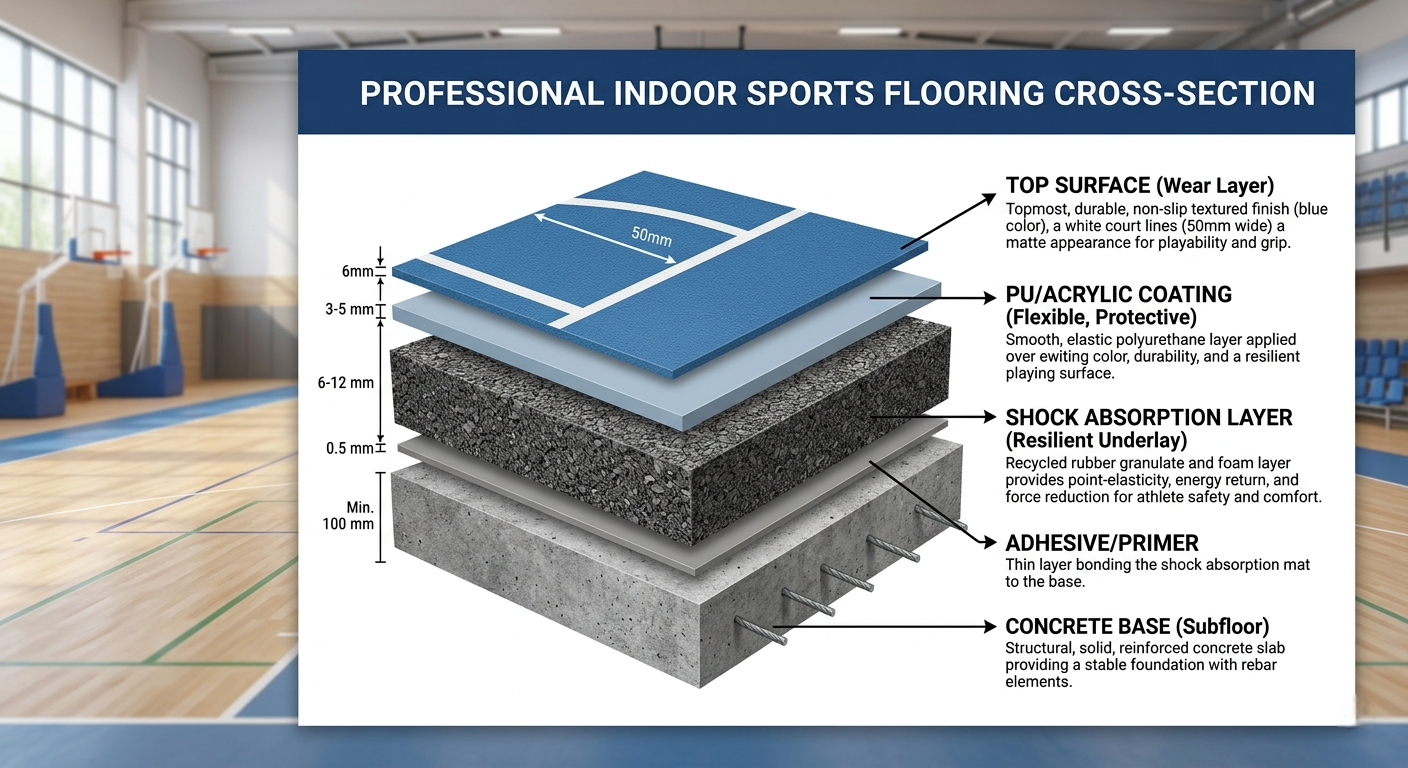
Sports flooring might look simple from the top- smooth, colorful, and perfectly marked. But what truly determines its performance, durability, and safety lies beneath the surface.
👉 Whether it’s a basketball court, badminton hall, or multi-sport facility, the foundation layers are what make or break the entire system.
🧱Why the Base Layers Matter
Before diving into layers, let’s understand one key thing:
⚠️ Most sports flooring failures happen because of poor sub-base work- not the top layer.
A strong base ensures:
- ✅ Long-lasting performance
- ✅ Shock absorption & player safety
- ✅ Crack resistance
- ✅ Proper drainage (for outdoor courts)
🔍 Complete Layer Breakdown (Step-by-Step)
🪨1. Subgrade (Natural Ground)
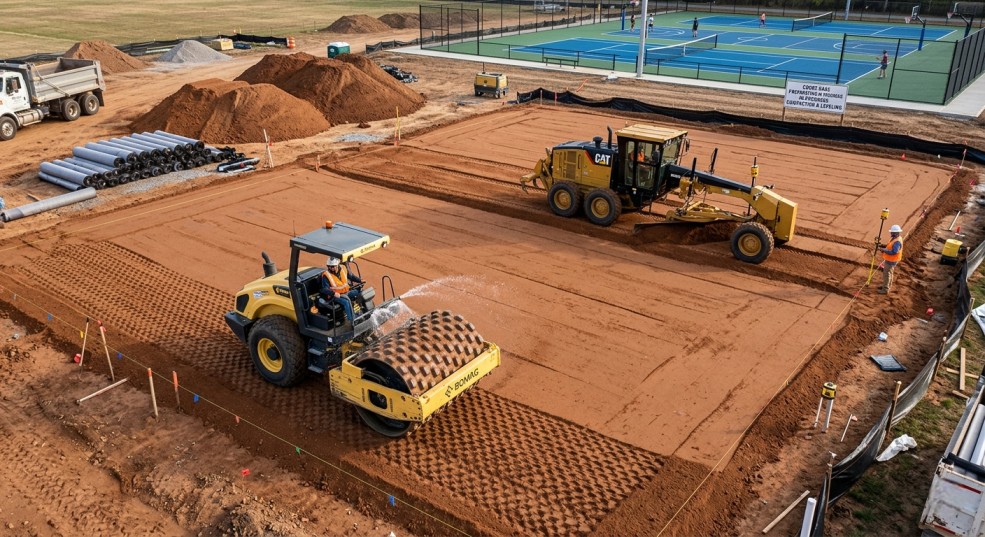
This is the original soil level where everything beings.
Key Functions:
- Supports the entire structure
- Must be compacted properly
- Prevents uneven settlement
Important Notes:
- Soil testing is recommended
- Poor compaction = future cracks ❌
🧱2. Sub-Base Layer (Granular Layer)
Placed above the soil, this layer usually consists of:
- Crushed stone
- Gravel
- Sand mix
Purpose:
- Improves load distribution
- Enhances drainage (especially outdoors)
- Provides a stable platform
🏢3. Concrete/Asphalt Base
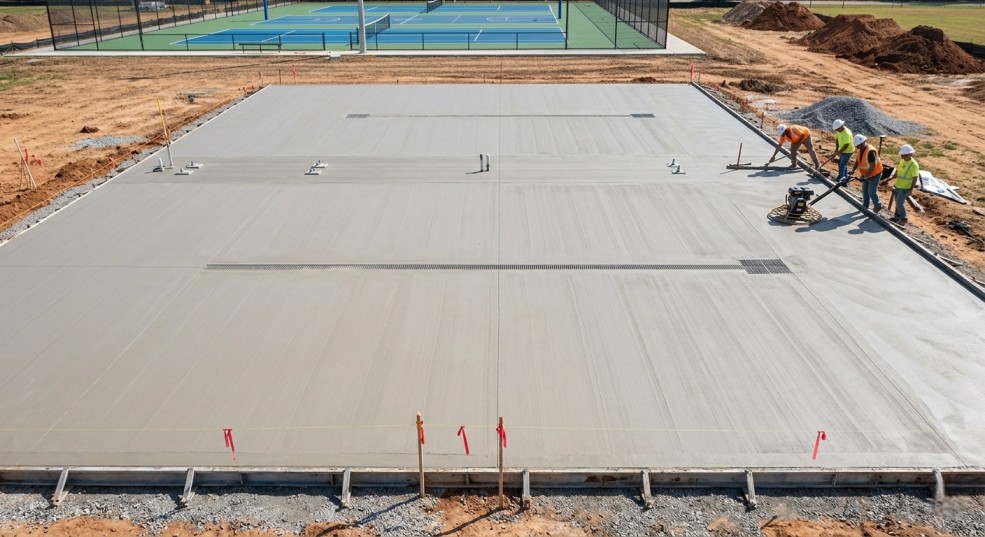
This is the main structural layer.
Types:
- PCC(Plain Cement Concrete)
- RCC (Reinforced Cement Concrete)
- Asphalt (for some outdoor courts)
Why it’s Critical:
- Gives strength & rigidity
- Ensures flat surface
- Acts as foundation for coatings
🧴4. Primer Layer
A thin but crucial layer applied over concrete.
Role:
- Improves bonding between base and flooring system
- Prevents peeling or delamination
🧽5. Cushion / Shock Absorption Layer
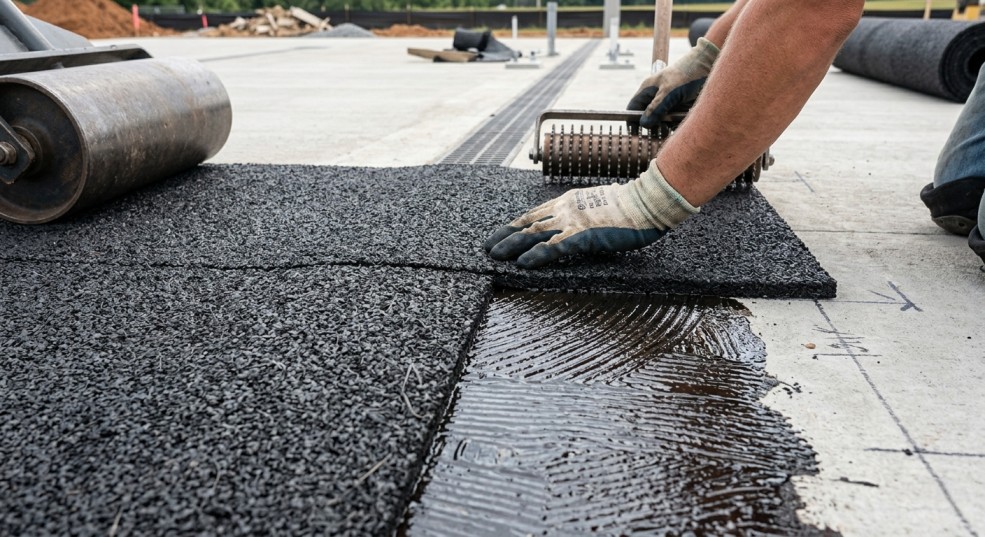
This is where player comfort and safety come in.
Materials:
- Rubber granules
- PU cushion layers
- Foam systems
Benefits:
- Reduces impact stress on joints
- Improves gameplay comfort
- Prevents injuries
🎨 6. Base Coating Layer
This layer prepares the surface for the final finish.
Includes:
- Acrylic base coats
- PU base layers
Purpose:
- Smoothens the surface
- Adds durability
🏀 7. Top Surface Layer (Final Playing Surface)
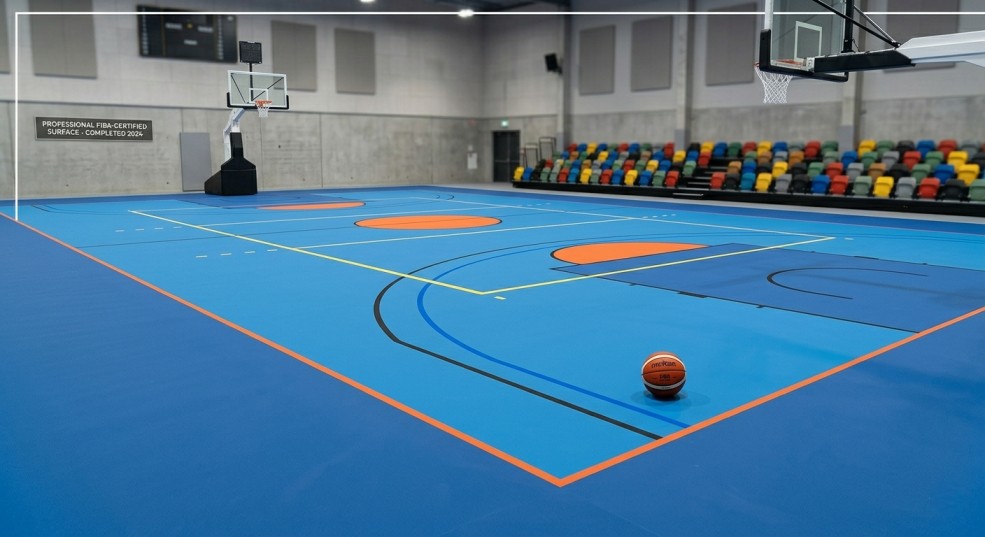
This is what you actually see.
Options:
- Acrylic sports flooring
- PU (Polyurethane) Flooring
- Vinyl or wooden (indoor)
Features:
- Anti-slip finish
- UV resistance (outdoor)
- Game markings
🖌️8. Line Marking & Finishing
Final step where courts becomes functional.
Includes:
- Game lines (basketball, badminton, etc.)
- Anti-skid coating
- Color finishing
📊 Comparison Table: Different Flooring Layer Systems
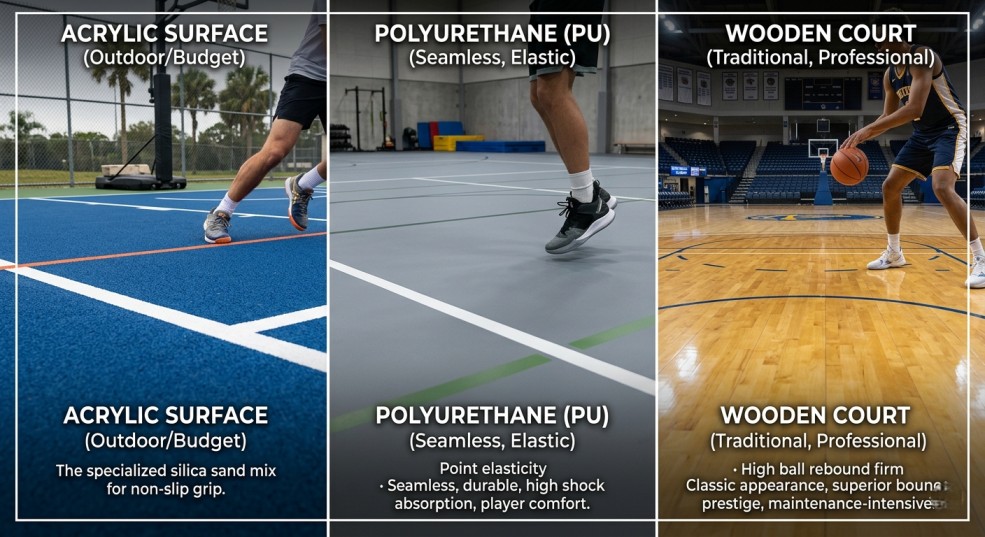
| Layer Component | Acrylic Flooring | PU Flooring | Wooden Flooring |
| Base Requirement | Concrete | Concrete | Wooden Subfloor |
| Cushion Layer | Minimal | High | Natural Flex |
| Shock Absorption | Medium | Excellent | Very High |
| Durability | High | Very High | Medium |
| Maintenance | Low | Medium | High |
| Best For | Outdoor courts | Indoor pro courts | Indoor sports halls |
🧠 Common Mistakes in Flooring Layers
🚫 Skipping proper soil compaction
🚫 Using low-quality concrete
🚫 Ignoring drainage system
🚫 Poor bonding between layers
🚫 No shock absorption layer
👉 These mistakes lead to:
- Cracks
- Surface peeling
- Water damage
- Reduced lifespan
❓FAQs
1. What is the most important layer in sports flooring?
👉 The concrete base and sub-base are the most critical.
2. Can sports flooring be installed without a cushion layer?
👉 Yes, but it reduces comfort and safety.
3. How thick is sports flooring?
👉 Usually ranges from 3mm to 15mm depending on system.
4. How long does sports flooring last?
👉5-15 years depending on material and maintenance.
5. Is drainage necessary for outdoor courts?
👉 Yes, absolutely essential.
6. What causes cracks in sports flooring?
👉 Poor base preparation and soil movement.
7. Which is better: PU or Acrylic flooring?
👉 PU for indoor comfort, Acrylic for outdoor durability.
8. Can flooring be installed on old surfaces?
👉 Yes, with proper surface preparation.
9. Is maintenance required?
👉 Yes, regular cleaning and inspection.
10. Does weather affect sports flooring?
👉 Yes, especially outdoor surface.
11. What is primer used for?
👉 To improve adhesion between layers.
12. How long does installation take?
👉7-20 days depending on size.
13. Is sports flooring waterproof?
👉 Most systems are water-resistant.
14. Can cracks be repaired?
👉 Yes, but early repair is important.
15. What is the cost factor?
👉 Depends on material, layers, and area.
16. Is synthetic flooring safe for players?
👉 Yes, if installed correctly.
17. Can multiple games be played on one surface?
👉 Yes, with multi-sport flooring.
18. Does thickness affect performance?
👉 Yes, thicker systems offer better cushioning.
🏁 Conclusion
Your sports flooring is only as good as what lies beneath it.
👉 A properly layered system ensures:
- 🏆 Better performance
- 🛡️ Player safety
- ⏳ Long-term durability

Proudly powered by MSG SPORTS INFRATEK INDIA LLP