
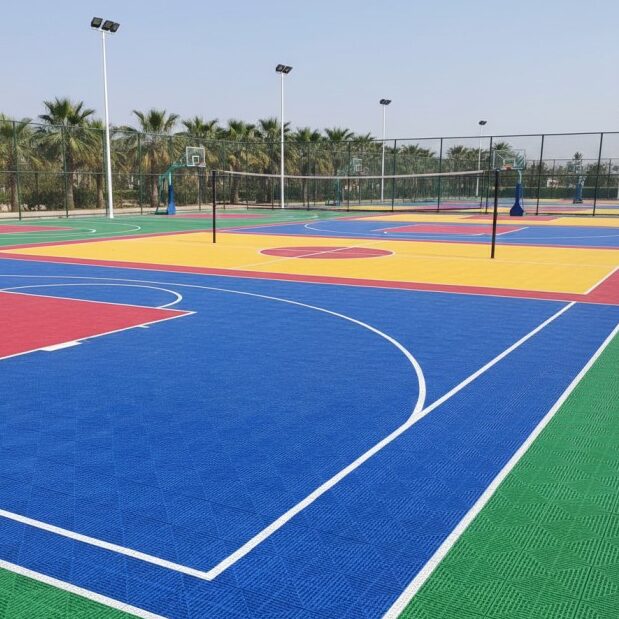
Modern sports flooring is no longer about providing a flat surface alone. Today, sports floors are engineered systems, designed to manage dynamic loads, repeated impacts, player safety, and long-term durability.
Among various sports flooring solutions, Sports PP (Polypropylene) Tiles stand out due to their advanced material science, structural design, and performance-driven engineering. Their success lies not in surface appearance, but in what happens beneath the player’s feet.
Material Science of Sports PP Tiles 🧪
Why Polypropylene?
Polypropylene (PP) is a thermoplastic polymer widely used in engineering applications due to its balanced mechanical properties:
For sport flooring, PP is selected because it offers:
- High strength-to-weight ratio
- Excellent fatigue resistance
- Chemical and moisture resistance
- Dimensional stability
- Consistent performance across temperature ranges
However, not all polypropylene is suitable for sports applications. Sports PP tiles use formulated polymer blends, optimized through additives and stabilizers.
Polymer Formulation & Additives
Sports PP tiles material typically includes:
- Impact-modified polypropylene for toughness
- UV stabilizers to resist degradation from sunlight
- Color masterbatches for long-term color retention
- Thermal stabilizers for heat resistance
These formulations ensure that tiles do not become brittles, retain mechanical integrity, and maintain surface performance over years of usage.
Injection Molding & Manufacturing Precision 🏭
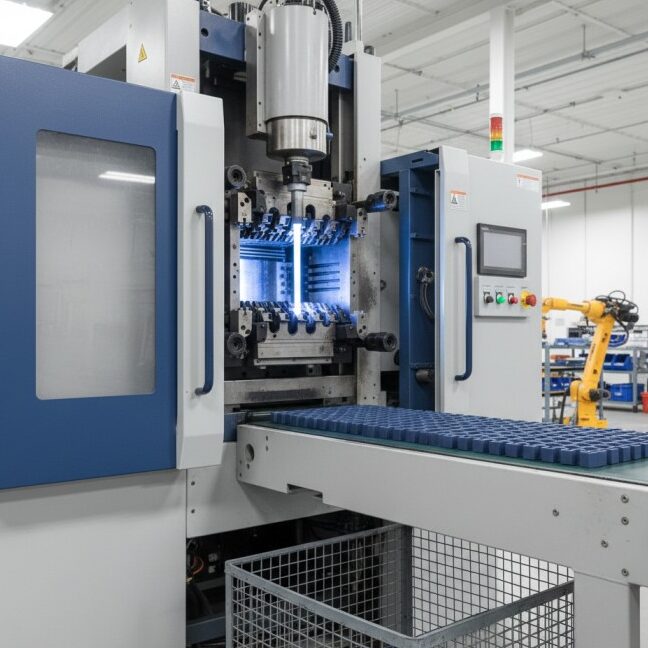
Sports PP tiles are manufactured using high-pressure injection molding, which allows:
- Uniform material distribution
- Precise dimensional control
- Consistent surface texture
- Strong interlocking edges
Injection molding ensures repeatability, which is critical for:
- Seamless interlocking
- Uniform court performance
- Consistent load transfer across tiles
Poor manufacturing precision leads to weak joints, uneven Surfaces, and early failure- which high-quality PP tile systems are designed to avoid.
Structural Engineering: Load Bearing Capacity 🧩
Understanding Load in Sports Flooring
Sports floors experience:
- Static loads (standing players, equipment)
- Dynamic loads (running, jumping, sudden stops)
- Point loads (heel strikes, pivots)
This engineering challenge is distributing these forces without concentrating stress on the base or joints.
Ribbed Sub-Structure Design
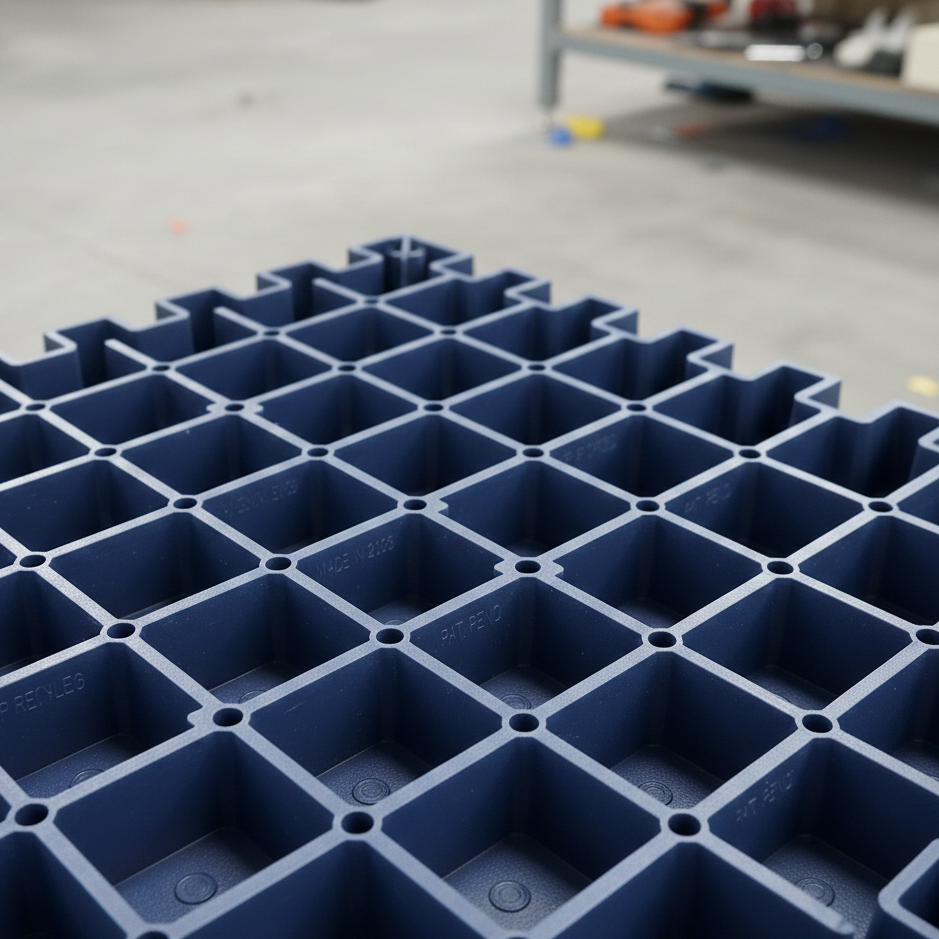
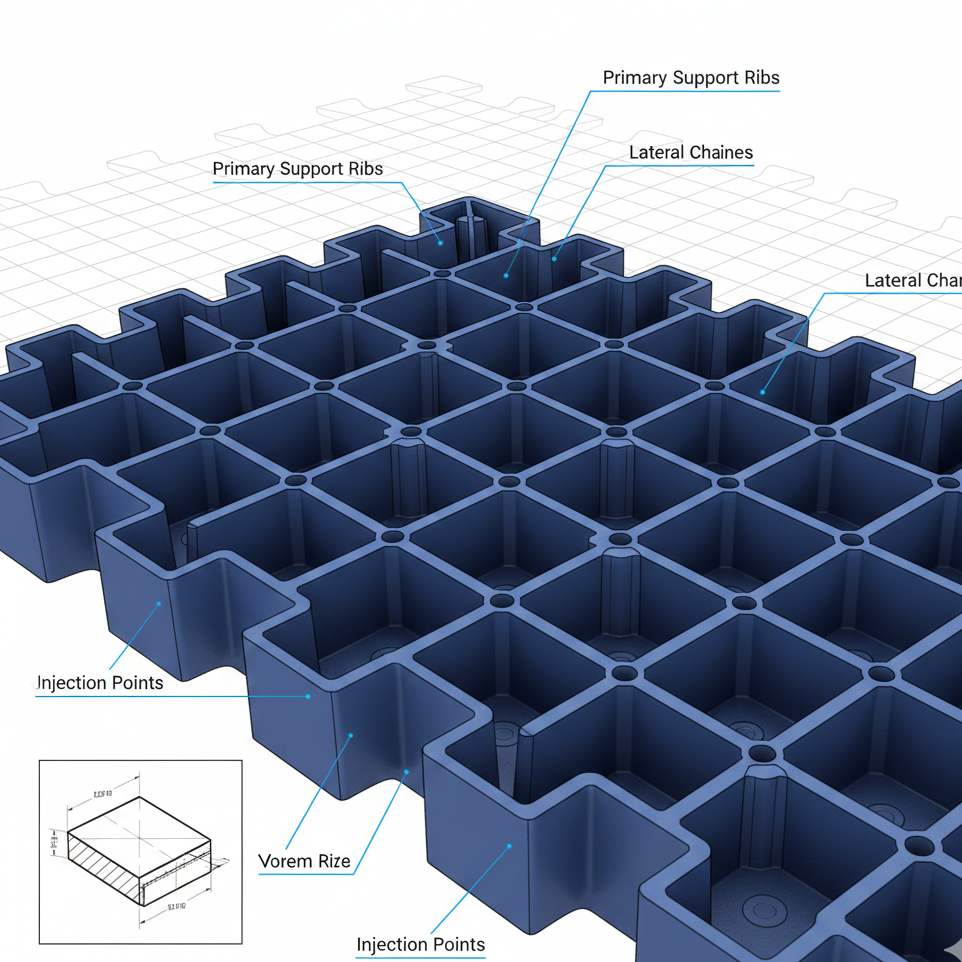
The underside of a sports PP tiles is its core engineering element.
Key design feature include:
- Multi-directional rib patterns
- Vertical support columns
- Load-spreading geometry
This structure:
- Distributes load evenly across the base
- Prevents localized deformation
- Maintains surface stability under heavy play
Unlike solid slabs, ribbed structures optimize strength without excessive material use.
Impact Resistance & Shock Absorption 🦵
Why Impact Resistance Matters
Repeated impact forces can:
- Cause player fatigue
- Increase injury risk
- Accelerate flooring failure
Traditional rigid surfaces reflect impact energy back to the body. Sports PP tiles are engineered to manage impact energy more effectively.
Controlled Vertical Deformation
PP tile systems are designed to allow micro-level vertical deflection under load.
This means:
- Impact energy is partially absorbed
- Stress is reduced on joints and muscles
- The floor recovers quickly after load removal
This controlled deformation is achieved through:
- Tile thickness
- Sub-structure geometry
- Material elasticity
Energy Return vs Energy Absorption Balance
A critical engineering goal is balancing:
- Shock absorption (Safety)
- Energy return (Sports performance)
Excessive softness reduces performance, while excessive rigidity increase injury risk. Well-engineered PP tiles maintain this balance through material tuning and structural design.
Surface Engineering & Traction Control 👟
The Playing surface of PP tiles is:
- Textured for controlled friction
- Designed to prevent slipping
- Optimized for directional movement
Surface textures are engineered to:
- Provide grip without abrasion
- Maintain traction even in slightly wet conditions
- Reduce uncontrolled foot locking
Environmental & Weather Engineering 🌦️
Outdoor sports PP tiles are engineered to handle:
- Temperature variation
- Rain and surface water
- UV exposure
Key features include:
- Integrated drainage channels to prevent water pooling
- Thermal expansion gaps within the interlock design
- UV-resistant polymer formulation
This allows courts to remain playable and structurally stable across seasons.
Comparison: Engineering Performance Perspective
| Engineering Aspect | Sports PP Tiles | Acrylic Flooring | Concrete |
| Load Distribution | Engineered Rib Structure | Surface Dependent | Poor |
| Impact Resistance | High | Low | Very Low |
| Shock Absorption | Controlled | Minimal | None |
| Crack Resistance | Excellent | Limited | Poor |
| Repairability | Modular | Difficult | Very Difficult |
| Weather Adaptability | High | Medium | Low |
Long-Term Structural Reliability 🔍
Because sports PP tiles:
- Do not rely on chemical curing
- Are not bonded rigidly to the base
- Allow micro-movement
They are less prone to cracking, delamination, or surface failure compared to traditional flooring systems.
This reliability is a direct result of engineering design, not marketing claims.
📌 Frequently Asked Question(FAQs)
1.What makes PP tiles suitable for sports use?
Ans:- Their engineered material formulation and structural design.
2. Are all PP tiles the same?
Ans:- No, performance depends on polymer quality and structural engineering.
3. How do PP tiles handle heavy player loads?
Ans:- Through ribbed load-distribution structures.
4. Do PP tiles absorb impact?
Ans:- Yes, through controlled vertical deformation.
5. Are PP tiles rigid or flexible?
Ans:- They are semi-flexible by design.
6. Do PP tiles crack over time?
Ans:- High-quality PP tiles are Crack-resistant.
7. How is traction controlled on PP tiles?
Ans:- Via engineered surface textures.
8. Are PP tiles safe for Joints?
Ans:- Yes, due to shock absorption properties.
9. Do PP tiles expand with heat?
Ans:- Thermal expansion is accounted for in design.
10. Can PP tiles be used outdoors?
Ans:- Yes, with UV-stabilized formulations.
11. How does injection molding help performance?
Ans:- It ensures consistency and strength.
12. Are PP tiles resistant to moisture?
Ans:- Yes, polypropylene is moisture resistant.
13. What role does the base play?
Ans:- A flat, stable base supports optimal performance.
14. Can damaged tiles affect load distribution?
Ans:- Only locally; tiles can be replaced.
15. Are PP tiles suitable for high-traffic courts?
Ans:- Yes, they are designed for heavy usage.
16. Do PP tiles lose elasticity over time?
Ans:- Quality formulations retain elasticity.
17. Are PP tiles environmentally stable?
Ans:- Yes, they resist environmental degradation.
18. Why are PP tiles preferred in modern sports facilities?
Ans:- Because of engineered performance and reliability.
Conclusion 🎯
The success of sports PP tiles is driven by engineering, not coincidence. Through advanced material science, precision manufacturing, load-bearing structures, and impact-resistant design, PP tile systems address the real demands of modern sports environments.
As sports infrastructure standards rise, engineered modular flooring systems like PP tiles represent the future of safe, durable, and high-performance sports surfaces.
Proudly powered by MSG Sports Infraket India LLP