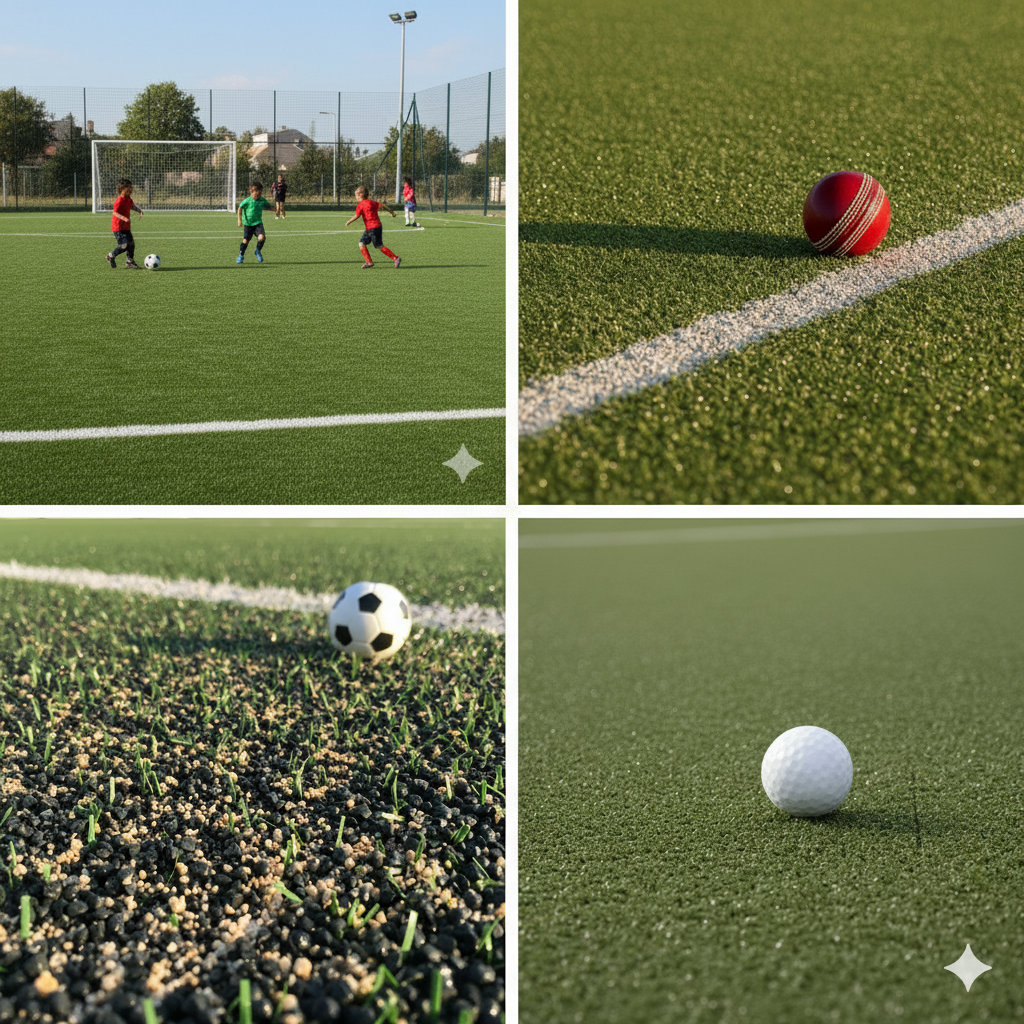
Choosing the right artificial sports turf is more than selecting a shade of green — it’s a technical decision that impacts player performance, safety, and long-term durability.
At MSG Sports Infratek India LLP, we design and install world-class synthetic surfaces that meet FIFA performance standards.This guide explains the key technical specifications — such as pile height, Dtex, infill, and shock absorption — that determine which turf system suits football, hockey, cricket, and multi-use sports grounds.
⚙️Understanding Core Turf Specifications
| Term | Definition | Why it Matters |
| Pile Height (mm) | The length of turf fibers from backing to tip. | Determines ball roll, energy return, and softness. |
| Dtex (Decitex) | Yarn linear density (grams per 10,000 meters). | Indicates fiber strength, weight, and durability. |
| Stitch Rate / Density | Number of Stitches per 10 cm | Affects surface stability and ball bounce. |
| Infill Type | Sand, rubber, or hybrid materials placed between blades | Controls shock absorption and traction |
| Shock Pad | Elastic underlay layer | Enhances cushioning and meets sports body certifications |
| Backing Type | Primary + secondary layer holding fibers | influences drainages, turf lock, and lifespan. |
⚽ Football Turf Specifications
Ideal Characteristics:
- Pile Height: 40 – 60 mm
- Dtex: 8,000 – 12,000
- Infill: Sand + rubber granules (SBR or EPDM)
- Shock Pad: 10 – 15 mm recommended
- Face Weight: 1,100 – 1,400 g/m²
Performance Goals:
- Natural ball roll and controlled bounce
- Shock absorption 55 – 70%
- Energy restitution for fast play
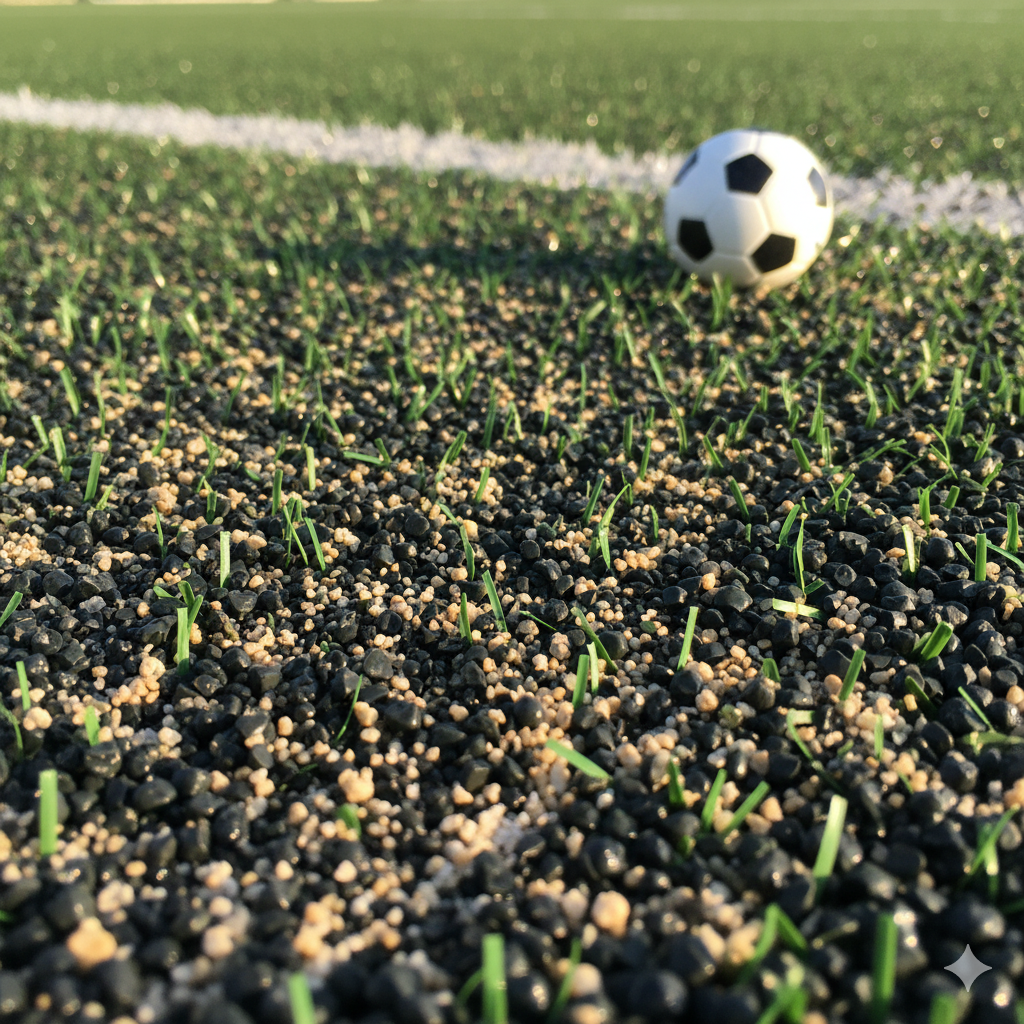
Artificial football turf surface with rubber and sand infill
🏑 Hockey Turf Specifications
Ideal Characteristics:
- Pile Height: 9 – 13 mm
- Dtex: 4,000 – 6,000
- Infill: Sand – filled (for multi-purpose) or water- based (elite hockey)
- Shock Pad: optional or 8 mm elastic pad
- Face Weight: 450 – 700 g/m²
Performance Goals:
- Smooth, fast surface for predictable ball glide
- Low friction for stick control
- Excellent traction and flatness tolerance
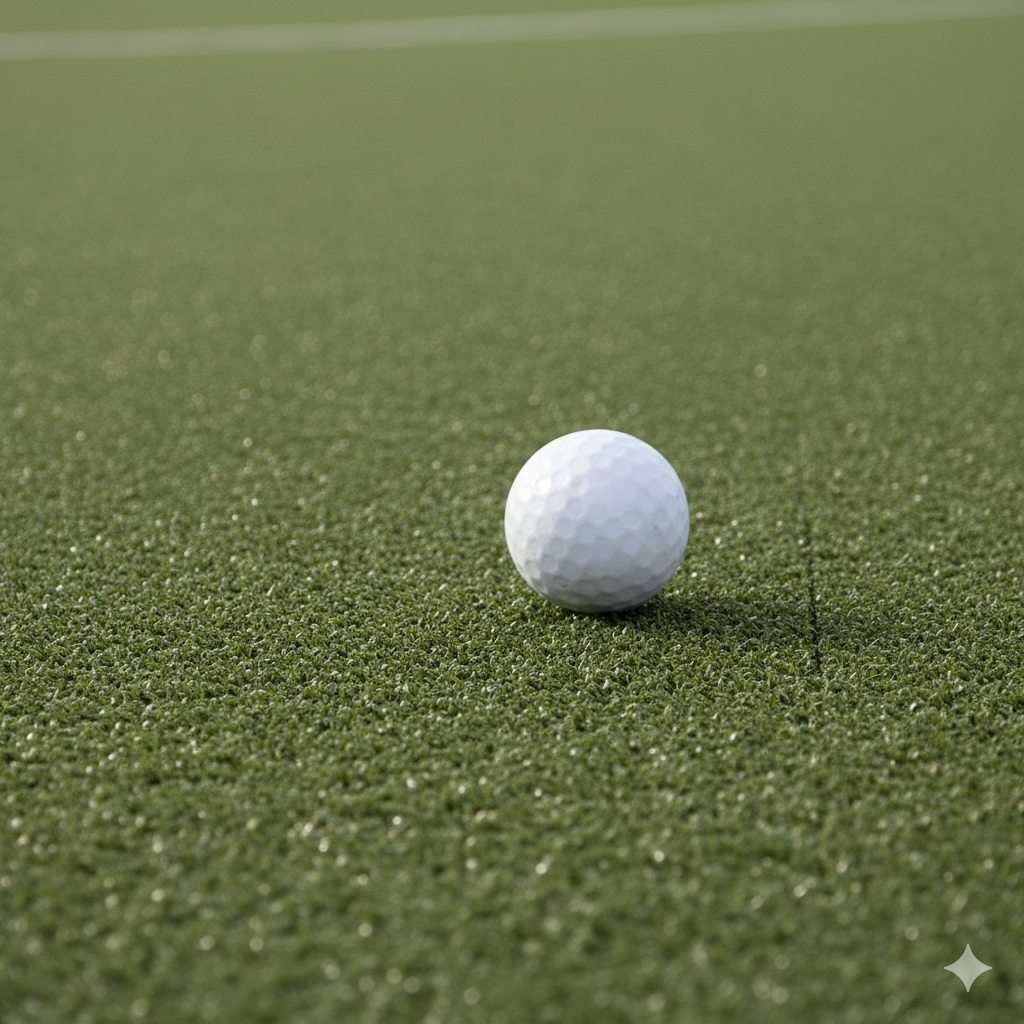
Close view of short pile hockey turf for fast ball roll
🏏 Cricket Turf Specifications
Ideal Characteristics:
- Pitch Area (Main Strip): 9–12 mm pile height
- Outfield: 20–35 mm pile height
- Dtex: 4,000–8,000
- Infill: Dense silica sand (pitch) + lighter sand/rubber (outfield)
- Shock Pad: Not used in pitch; 10 mm pad under outfield optional
Performance Goals:
- True ball bounce from the pitch area
- Safe fielding surface with consistent pace
- UV & heat resistance for Indian climate
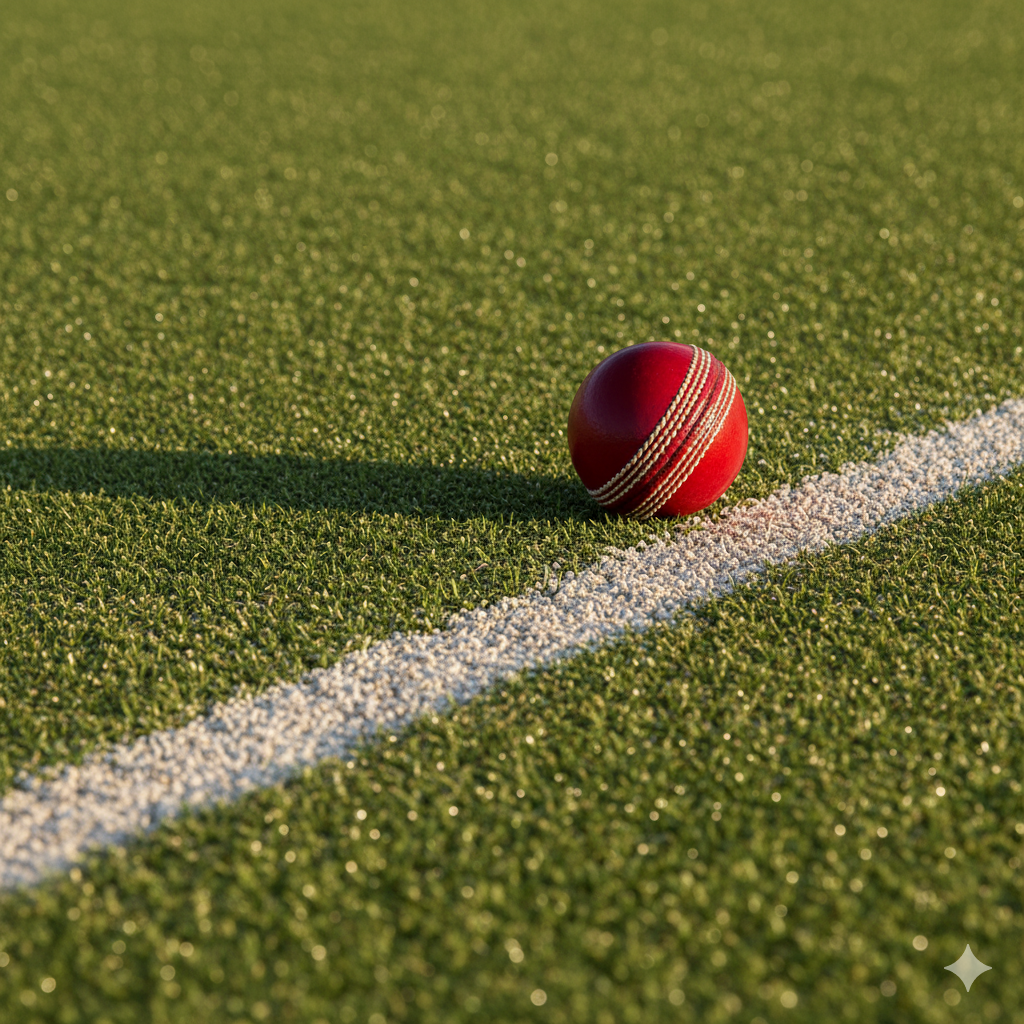
Artificial cricket pitch with short dense pile and sand infill.
📊 Compression & Dtex Comparison Table
| Sport / Use | Pile Height (mm) | Typical Dtex | Approx. Face Weight(g/m²) | Residual Thickness after Compression (mm)* | Recommended Infill | Shock Pad (mm) |
| Football (Pro) | 50-60 | 8,000-12,000 | 1,100 – 1,400 | 25 – 35 | Sand + Rubber | 10 – 15 |
| Football (Training) | 40-45 | 7,000 – 10,000 | 950 – 1,200 | 20 – 30 | Sand + Rubber | 8 – 10 |
| Hockey (Water-Base) | 9-13 | 4,000 – 6,000 | 450 -700 | 4 -6 | Water layer | Optional(8) |
| Hockey (Sand- Filled) | 12-15 | 4,000 – 7,000 | 600 – 800 | 6 – 8 | Silica Sand | Optional |
| Cricket Pitch | 9-12 | 4,000 – 8,000 | 500 – 750 | 4 – 7 | Silica Sand | None |
| Cricket Outfield | 25-35 | 6,000 – 8,000 | 800 – 1,000 | 10 -15 | Sand + Light Rubber | Optional(10) |
| Multi-Use Grounds | 15-25 | 5,000 – 9,000 | 700 – 900 | 8 -12 | Sand or Non-infill | 10 |
* Residual thickness values are indicative. Actual compression depends on yarn polymer, infill type, and test load.
🌦️ Climate & Durability Considerations (India-specific)
In tropical regions like India, where temperatures often exceed 40°C and heavy monsoon rains test drainage systems, the following specs are essential:
- UV – Stabilized polyethylene yarns with >= 8,000 Dtex
- Perforated latex or PU backing for rapid drainage
- Heat-resistant infill (EPDM preferred over SBR for high-UV regions)
- Non-infill multi-sport systems for low-maintenance schools and gyms
📋 Compliance Standards to Reference
When specifying or tendering projects, refer to:
| Standard | Description | Applies To |
| FIFA Quality | International football Performance standards | Football fields |
| FIH Global / National | Hockey surface certification | Hockey turfs |
| ICC / ECB Practice Guidelines | Cricket pitch & outfield recommendations | Cricket |
| EN 15330 / ASTM F1936 | Synthetic surface construction standards | All synthetic sports fields |
🧰 Installation & Maintenance Notes
- Sub-base: Compacted stone layer (150 – 250 mm) + drainage layer.
- Shock pad: Always pre- tested for vertical deformation and energy restitution.
- Infill levelling: Maintain consistent layer depth; re-top every 6 – 12 months.
- Brushing: Weekly brushing keeps fibers upright and even.
- Testing: Post – installation field testing for ball roll, bounce, and shock absorption ensures conformity.
✅ Key Takeaways
- Pile height and Dtex directly define sport – specific performance.
- Football: 50 – 60 mm pile >= 8,000 Dtex for realism and shock absorption.
- Hockey: 9 – 13 mm pile, <= 6,000 Dtex for smooth, fast play.
- Cricket: Short dense pitch pile(9 -12 mm) with sand infill for pace.
- Multi- use: 15 – 25mm medium pile with shock pad for safety.
- Always source from tested, certified turf systems – MSG Sports Infratek India LLP ensure full compliance and professional installation.
🧠 Frequently Asked Questions (FAQ)
1. What is Dtex in sports turf and why is it important ?
Answer:
Dtex (decitex) measures the linear density of turf yarns — how many grams 10,000 meters of fiber weigh.
A higher Dtex means thicker, heavier fibers that resist wear and matting.
For sports fields, MSG Sports Infratek India LLP typically recommends 8,000–12,000 Dtex for football and 4,000–6,000 Dtex for hockey, depending on sport intensity.
2. Which pile height is best for football fields?
Answer:
For professional and training football fields, the ideal pile height is 40–60 mm, paired with sand + rubber infill and a 10–15 mm shock pad.
This range ensures a realistic ball roll, proper traction, and cushioning for players.
3. Can the same artificial turf be used for both football and hockey?
Answer:
No — both sports require very different playing characteristics.
- Football surfaces are taller and softer (≈50 mm pile).
- Hockey surfaces are short and smooth (≈13 mm pile).
If you need to host both, a multi-use hybrid system with ~20 mm pile can offer balanced playability.
4. How does Dtex affect turf durability and performance?
Answer:
Dtex influences how strong and springy each turf blade is.
- Lower Dtex (3,000–6,000): Softer feel, faster ball roll — ideal for hockey.
- Higher Dtex (8,000–12,000): Thicker blades, slower ball roll — ideal for football or cricket outfields.
A correctly chosen Dtex ensures consistent performance and long life under heavy use.
5. What compression or residual thickness should I expect after installation?
Answer:
Under typical play conditions, artificial turf compresses about 20–40% of its pile height.
For example, a 50 mm football turf may compress to 30–35 mm under load.
This depends on Dtex, infill density, and shock pad thickness — all factors optimized by MSG Sports Infratek India LLP during design.
6. What infill materials are best for different sports?
Answer:
- Football: Sand + SBR or EPDM rubber mix for resilience.
- Hockey: Silica sand (dry) or water layer for elite surfaces.
- Cricket: Silica sand for the pitch, lighter infill for outfields.
- Multi-use: Sand-filled or non-infill systems for easy maintenance.
7. Do I need a shock pad under my turf?
Answer:
Yes, for most sports fields a shock pad (8–15 mm) is essential to achieve required shock absorption and vertical deformation standards.
It improves safety, comfort, and ball response — especially on football and playground surfaces.
8. How long does artificial sports turf last?
Answer:
With proper installation and maintenance, sports turf systems last 8–12 years.
Durability depends on yarn Dtex, UV stability, infill maintenance, and local climate.
MSG Sports Infratek India LLP uses UV-stabilized polyethylene yarns designed for Indian conditions to ensure long-term performance.
9. How do I maintain an artificial sports field?
Answer:
Regular brushing, debris removal, infill top-up, and periodic testing keep your turf performing optimally.
For heavy-use grounds, a monthly grooming plan and annual surface inspection are recommended.
10. Does turf performance vary with Indian climate?
Answer:
Yes — heat, UV exposure, and monsoons can stress low-quality surfaces.
Choosing UV-resistant, heat-tested yarns and perforated backing systems ensures durability in Indian weather.
All turf systems by MSG Sports Infratek India LLP are engineered specifically for such conditions.