
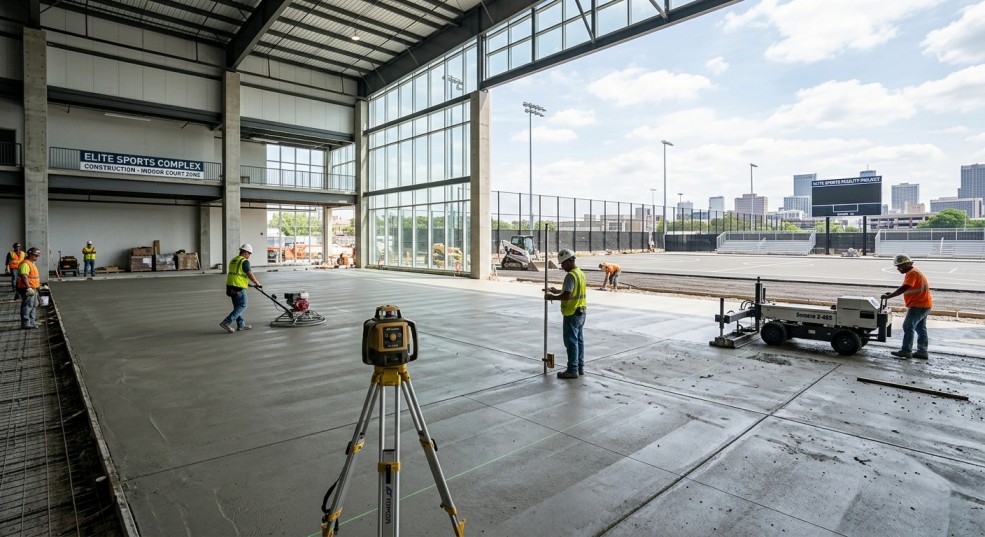
A beautiful sports court is not defined only by its colorful surface or professional game marking. The real strength of any sports flooring lies beneath the surface.
Whether you’re installing an acrylic basketball court, a PU indoor court, a badminton court, or a multi-purpose sports surfaces, subfloor preparation is one of the most critical stages of the entire construction process.
Unfortunately, many people focus only on the final flooring material while overlooking the quality of the foundation. Even the highest-quality sports flooring cannot perform well if it is installed over a poorly prepared subfloor.
🏟️ What is a Subfloor?
A subfloor is the structural base on which the sports flooring system is installed.
Think of it as the foundation of a building.
Just as a strong building requires a solid foundation, every sports court requires a properly prepared subfloor to ensure stability, safety and durability.
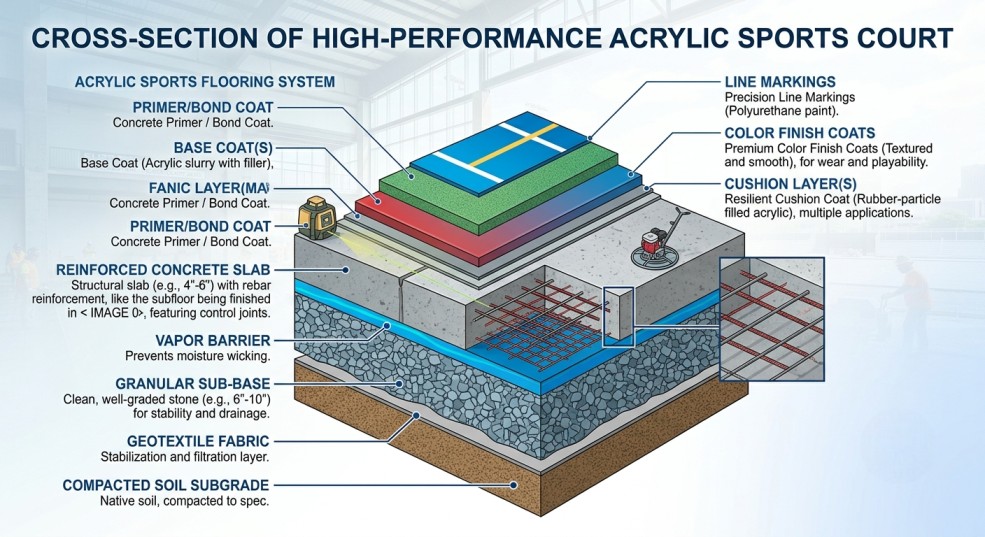
Depending on the project, the subfloor may consist of:
✅Compacted soil
✅ Granular sub-base
✅ Concrete slab (RCC/PCC)
✅ Asphalt base (for selected outdoor applications)
🎯Why is Subfloor Preparation So Important?
A properly prepared subfloor supports the entire sports flooring system throughout its service life.
Good subfloor preparation helps achieve:
✔️ Long-lasting durability
✔️ Better player safety
✔️ Uniform ball bounce
✔️ Proper drainage
✔️ Crack prevention
✔️ Improved flooring adhesion
A poorly prepared subfloor often leads to expensive repairs within just a few years.
🔍 Step-by-Step Subfloor Preparation Process
🪨 Step 1: Site Inspection
Before construction begins, the project site should be thoroughly inspected.
Engineers evaluate:
- Soil condition
- Moisture level
- Existing surface
- Drainage direction
- Ground stability
Proper planning at this stage helps avoid major issues later.
🚜 Step 2: Ground Excavation & Leveling
The site is excavated according to the project design.
The ground is then leveled carefully to achieve the required elevation.
Proper leveling ensures:
- Even playing surface
- Accurate court dimensions
- Efficient drainage
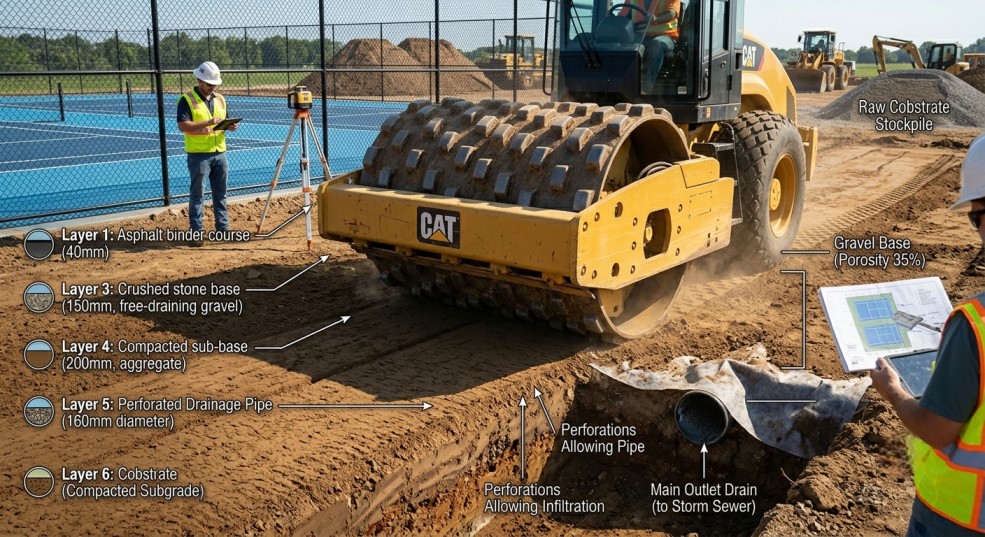
🏗️ Step 3: Soil Compaction
One of the most overlooked but essential steps.
Compaction increases the strength of the soil and minimizes future settlement.
Proper compaction helps prevent:
❌ Surface sinking
❌ Uneven flooring
❌ Structural movement
Heavy compaction equipment is commonly used to achieve the required density.
🪨 Step 4:- Granular Sub-Base Installation
A layer of crushed stone or aggregate is installed above the compacted soil.
Benefits:
✔️ Better load distribution
✔️ Improved drainage
✔️ Enhanced structural stability
This layer acts as the transition between the soil and the concrete base.
Step 5: Concrete Base Construction
The concrete slab becomes the primary structural support for the sports flooring.
Important considerations include:
- Concrete grade
- Thickness
- Surface finish
- Curing time
A properly cured slab significantly reduces the chances of future cracking.
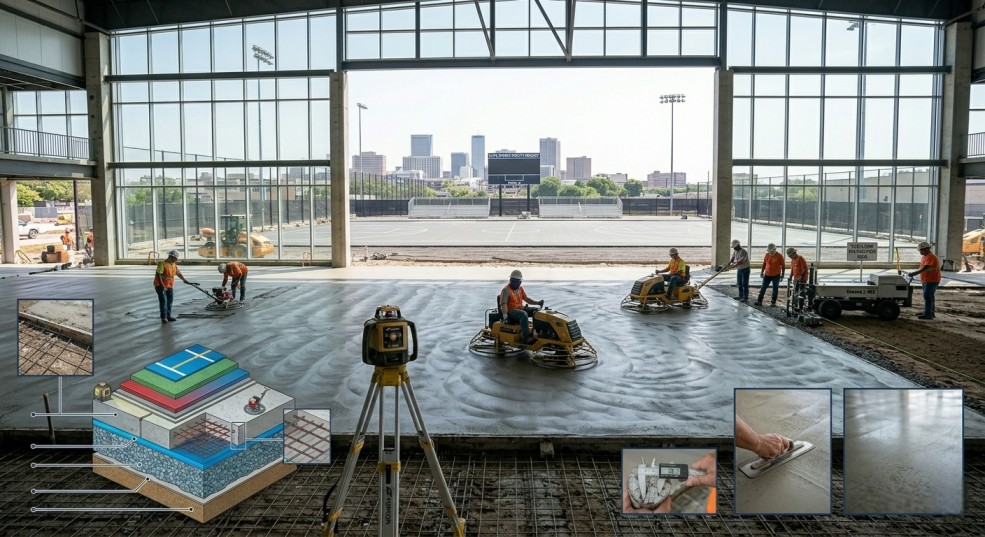
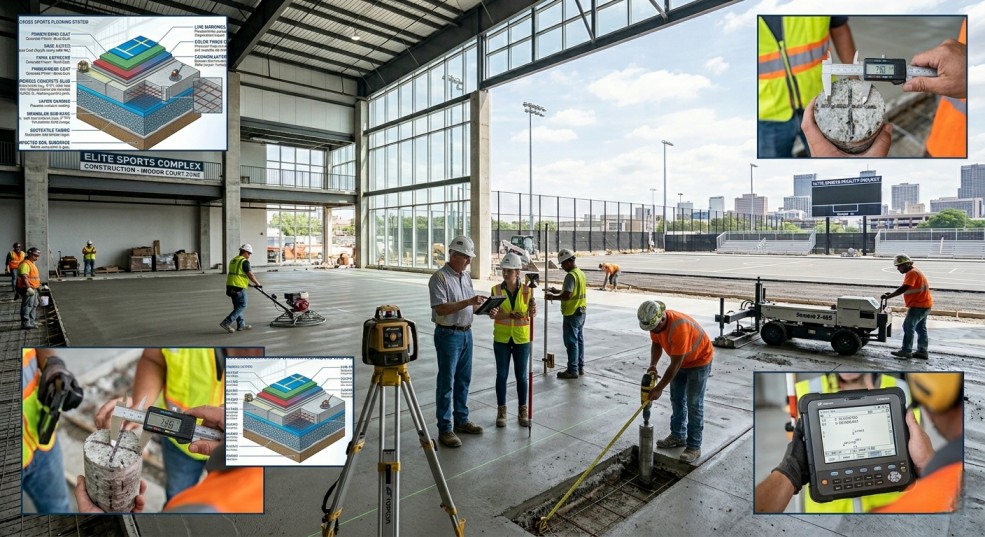
Step 6: Surface Level Checking
Even minor variations in surface level can affect sports performance.
Professional use:
- Laser leveling equipment
- Straight edges
- Precision measuring tools
This ensure the surface meets construction tolerance before flooring installation.
Step 7: Surface Cleaning & Preparation
Before the sports flooring system is applied:
✔️ Dust is removed
✔️ Loose particles are cleaned
✔️ Moisture levels are checked
✔️ Surface imperfection are repaired
This improves bonding between the flooring system and the base.
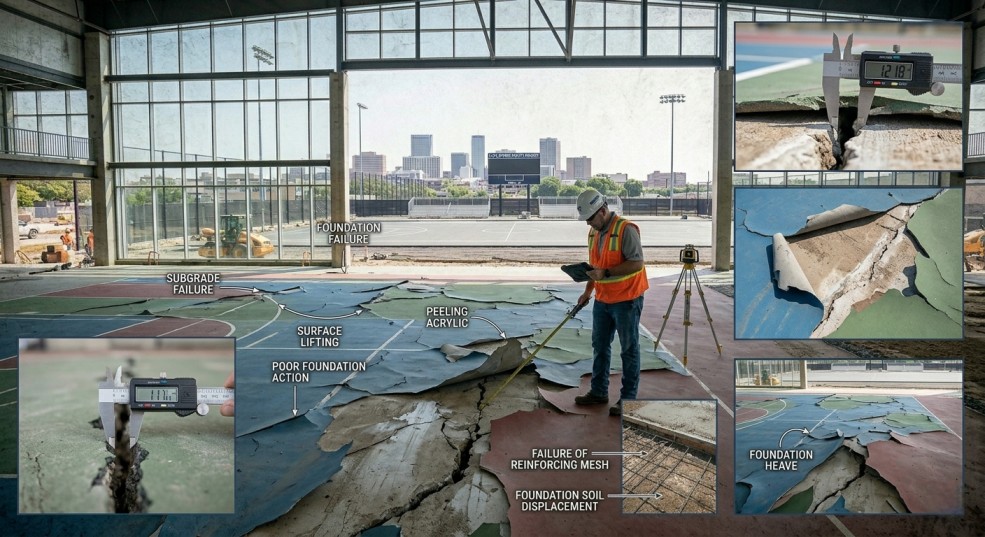
🚨 Common Problems Caused by Poor Subfloor Preparation
When shortcuts are taken during construction, several problems may appear later.
These include:
❌ Surfaces Cracks
❌ Uneven ball bounce
❌ Water accumulation
❌ Coating delamination
❌ Surface bubbling
❌ Premature flooring failure
Most of these issues begin below the surface rather than in the acrylic or PU coating itself.
⚖️ Well-Prepared vs Poorly Prepared Subfloor
| Feature | ✅ Properly Prepared Subfloor | ❌ Poorly Prepared Subfloor |
| Surface Level | Excellent | Uneven |
| Drainage | Efficient | Water Ponding |
| Crack Resistance | High | Low |
| Flooring Bond | Strong | Weak |
| Ball Performance | Consistent | Inconsistent |
| Player Safety | High | Reduced |
| Maintenance Cost | Lower | Higher |
| Flooring Lifespan | Longer | Shorter |
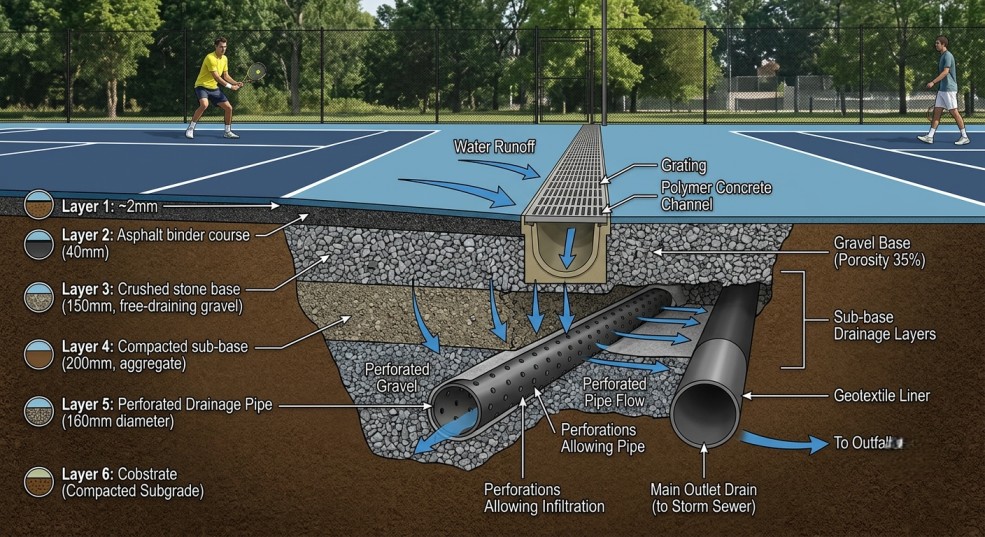
🌧️ Importance of Drainage in Subfloor Preparation
Water is one of the biggest threats to outdoor sports flooring.
A properly designed subfloor allows rainwater to drain efficiently.
Without adequate drainage:
💧Water remains trapped
💧 Moisture weakens the concrete
💧 Cracks develop over time
Drainage planning should always be part of subfloor construction.
🏀 How Subfloor Preparation Improves Sports Performance
Many people assume that player performance depends only on the surface coating.
In reality, the subfloor affects:
🏃 Player Movement
⚽ Ball response
🎾 Surface consistency
🦵 Shock absorption
🎯 Court stability
Professional-quality courts always begin with professional-quality foundations.
🛠️ Best Practices for Professional Subfloor Preparation
✔️ Conduct soil testing before construction
✔️ Use proper compaction equipment
✔️ Install a quality granular sub-base
✔️ Use the recommended concrete grade
✔️ Follow proper curing procedures
✔️ Maintain accurate surface levels
✔️ Design an effective drainage system
✔️ Perform final quality inspections before flooring installation
💡 Pro Tip: Never Rush the Foundation
One of the biggest mistakes in sports courts construction is trying to save time during foundation work.
Although subfloor preparation is not visible after construction, it directly determines:
🏆 Court performance
🛡️ Player safety
💰Maintenance costs
⏳Overall service life
A few extra days spent on proper preparation can prevent years of repair work.
❓Frequently Asked Questions
1. What is a subfloor in sports flooring?
👉 It is the structural base that supports the entire flooring system.
2. Why is subfloor preparation important?
👉 It ensures durability, stability, and proper flooring performance.
3. Can good flooring fail because of a poor subfloor?
👉 Yes. Even premium flooring can fail if the foundation is weak.
4. What is the first step in subfloor preparation?
👉 Site inspection and soil evaluation.
5. Why is soil compaction necessary?
👉 It prevents settlement and structural movement.
6. Does poor drainage damage sports flooring?
👉 Yes. Water accumulation can lead to cracks and deterioration.
7. How flat should the concrete base be?
👉 It should meet the required level tolerances specified for the flooring systems.
8. Can uneven subfloors affects gameplay?
👉 Yes. They can impact ball bounce and player movements.
9. How long should concrete cure before flooring installation?
👉 The curing period depends on the concrete mix and environmental conditions. Always follow the manufacture’s and engineer’s recommendations.
10. Can Cracks in the concrete affect the flooring?
👉 Yes. They may reflect through the surface if not repaired.
11. What is a granular sub-base?
👉 A layer of crushed stone or aggregate that improves stability and drainage.
12. Is moisture testing necessary?
👉 Yes. Excess moisture can reduce flooring adhesion.
13. Does every sports court need drainage?
👉 Outdoor courts definitely require proper drainage system.
14. How often should the foundation be inspected?
👉 During construction and before flooring installation.
15. Can a damaged subfloor be repaired?
👉 Yes, depending on the severity of the damage.
16. Is subfloor preparation different for indoor and outdoor courts?
👉 Yes. Outdoor courts place greater emphasis on drainage, while indoor courts focus more on moisture control and surface flatness.
17. Can poor subfloor preparation increase maintenance costs?
👉 Absolutely. It is one of the leading causes of premature repairs.
18. Is laser leveling used in sports courts construction?
👉 Yes. It helps achieve accurate surface levels.
19. Can proper subfloor preparation extend flooring life?
👉 Yes, It significantly improves durability and long-term performance.
20. Is subfloor preparation worth the investment?
👉 Without a double. It is one of the most important investments in any sports flooring projects.
🏁 Conclusion
A sports flooring system is only as strong as the foundation beneath it.
While colorful coatings and premium materials attract attention, the real performance any court depends on proper subfloor preparation. From soil compaction and drainage planning to concrete construction and surface leveling, every step contributes to a court that is safer, more durable, and easier to maintain.

Proudly powered by MSG SPORTS INFRATEK INDIA LLP